How Much Down Payment Do You Need? Closing Costs, Concessions & First-Time Paths
By Michael Hubbard, Founder & editor · Published June 9, 2026 · Updated September 11, 2026 · 9 min read
The old 20% down rule still matters for avoiding PMI, but it is not the minimum I would tell a 2026 buyer they “need.” Conventional loans start at 3% down for many qualified first-time buyers, FHA at 3.5% (or 10% with thinner credit), and VA or USDA at 0% when eligible. Closing costs sit on top of the down payment, not inside it — typically another 2–5% of the loan. Seller concessions and temporary buydowns can move cash to close as much as a small rate change moves the payment. I balance cash reserves, mortgage insurance duration, and rate pricing. I do not pick a down-payment percent because a relative said real buyers put 20% down.
Common down payment options
- Conventional: about 3–5% for many first-time buyers; 20% avoids PMI.
- FHA: 3.5% with a 580+ credit score; typically 10% if your score is 500–579 — and MIP duration improves at 10%+ down (see the 11-year rule in our FHA vs conventional guide).
- VA: $0 down for eligible service members and veterans (funding fee may be financed; some disabled veterans are exempt) — VA entitlement guide.
- USDA: $0 down in eligible rural areas (income and property limits apply).
| Down payment | Cash down | Loan | P&I | MI (modeled) |
|---|---|---|---|---|
| 0% VA (eligible) | $0 | $350,000 | See VA calculator | None (funding fee may apply) |
| 3.5% FHA | $12,250 | $337,750 base | Plus MIP | Upfront + annual MIP |
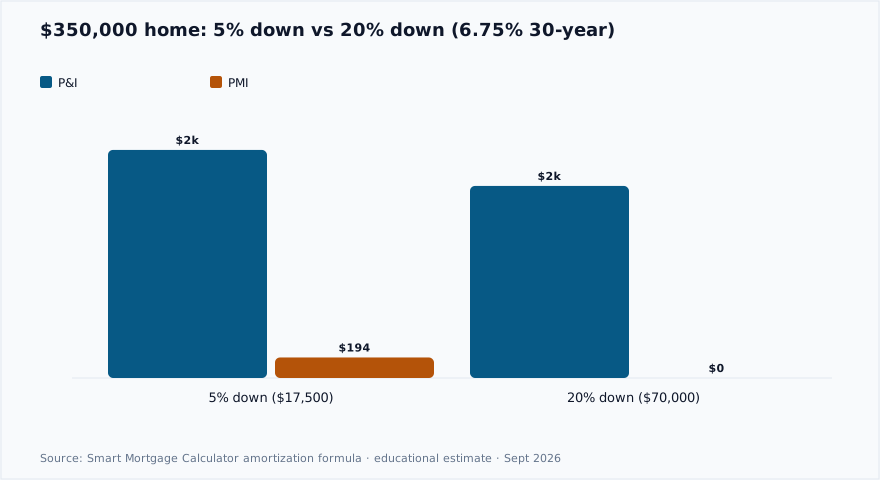
| 5% conventional | $17,500 | $332,500 | $2,157 | About $194/month |
| 20% conventional | $70,000 | $280,000 | $1,816 | $0 |
What changes when you put less down
A smaller down payment means a larger loan, a higher monthly payment, and usually mortgage insurance. On a $350,000 home, 5% down ($17,500) versus 20% down ($70,000) can add $200+ to the monthly payment once PMI is included — even at the same interest rate. I ran that comparison myself: P&I went from $2,157 to $1,816, and PMI at 0.70% annual added another $194 on the 5% path. The monthly gap was about $535, not the $341 I would have guessed from loan size alone. With FHA, putting less than 10% down often means annual MIP for the life of the loan. Details: PMI removal.
Closing costs: what you pay at the table
Closing costs are the fees to finalize the mortgage, separate from down payment. On a $280,000 loan, 2–5% is roughly $5,600 to $14,000. The lender must provide a Loan Estimate early and a Closing Disclosure before signing; I compare them line by line because that is where “we already quoted you” quietly changes. Prepaid escrow items can look large in high-tax or high-insurance counties even when lender fees are competitive. I keep a payment calculator and a cash-to-close worksheet as two different documents. Mixing them is how people think they cannot afford a house they can, or the reverse.
- Loan origination and underwriting fees.
- Appraisal and credit-report fees.
- Title search, title insurance, and escrow/settlement fees.
- Prepaid property taxes and homeowners insurance.
- Recording fees and, in some areas, transfer taxes.
- Discount points or, conversely, lender credits that offset fees.
A lower monthly payment does not mean lower cash to close. Points, larger prepaid taxes, and HOA move-in fees can spike day-of funding. Use the mortgage calculator for the recurring payment and keep a separate closing-cost worksheet for cash at the table. Shop multiple lenders and compare Loan Estimates line by line the same day; ask the preferred lender to match competing origination fees. Consider lender credits against a higher rate — run break-even like you would for points (rate shopping guide). Prepaid taxes are still cash due at closing even though they are not lender profit. Rolling costs into the loan is only allowed within LTV and program rules; it raises the balance and payment.
Seller concessions and rate buydowns
When inventory sits or a seller needs certainty, concessions can fund your closing costs, prepaid items, or a temporary rate buydown. Done well, a credit improves cash to close without confusing the appraisal. Done poorly, it looks like an undisclosed price cut, blows past program caps, or leaves you unprepared for the payment after a buydown expires.
- Conventional: often about 3% of the purchase price with less than 10% down, about 6% with 10–24.99% down, and about 9% with 25%+ down on primary residences (investment property caps are tighter) — confirm current agency/investor rules.
- FHA: commonly up to about 6% of the lesser of price or appraised value toward allowable closing costs and prepaid items.
- USDA: commonly up to about 6% toward allowable costs.
- VA: seller concessions (a defined category under VA rules) generally limited to about 4% of the reasonable value for certain items — distinct from normal discount points in many lender readings; verify with a VA lender.
Prefer contract language that the seller contributes a stated dollar amount toward buyer's allowable closing costs, prepaids, and/or rate buydown rather than quietly inflating price to rebate cash outside the settlement statement. Inflated price strategies can fail appraisal or create LTV problems.
- Closing-cost credit: reduces cash to close; payment unchanged except where prepaid escrow shrinks.
- Permanent discount points: buy a lower note rate for the life of the loan — run holding-period break-even.
- Temporary buydown (for example 2-1): subsidy account lowers the payment in year one by about 2 percentage points and year two by about 1 point (structures vary), then the payment rises to the note rate.
Suppose the note rate is 6.75% on a $350,000 loan. A classic 2-1 buydown makes year-one payments as if the rate were about 4.75% and year-two as if about 5.75%, with years three onward at 6.75%. Someone — buyer, seller, builder, or lender — must fund the subsidy equal to the payment differences. Many lenders underwrite at the note rate, not the bought-down payment. I model the post-buydown PITI so year three does not shock the budget. An $8,000 price cut saves a little principal and interest but may not help a cash-strapped buyer close; the same $8,000 as a closing-cost credit can unlock the purchase. I would rather have the credit when cash to close is the constraint.
Gift funds, DPA, and state programs
Many first-time buyers use gift funds from family or down-payment assistance (DPA) layered with FHA or conventional. Rules differ on who can gift, how funds are documented, and whether assistance is a silent second. State Housing Finance Agency products and Mortgage Credit Certificates can further improve post-close cash flow — ask local lenders which programs they actually close, not just which ones exist on paper.
Georgia first-time path (2026)
Buying a first home in Georgia is less stressful when I know the steps, which is why I wrote them down. With median prices often in the mid-$300,000s statewide and effective property taxes often near roughly 0.8%, Georgia remains more approachable than many coastal markets. Atlanta metro prices run higher than Franklin, rural west Georgia, and a lot of small cities. I am not going to pretend my county is the whole state.
- Set a realistic budget with the 28/36 rule, then stress-test taxes and insurance in the affordability calculator and affordability guide.
- Pull credit, dispute errors, pay down revolving balances, and avoid new credit before you apply — credit prep.
- Explore Georgia Dream and related DCA assistance for eligible first-time buyers — verify current income limits and home price caps on official DCA materials. Ask whether a Mortgage Credit Certificate stacks with your loan type.
- Gather pay stubs, W-2s or tax returns, and bank statements. Compare written Loan Estimates from at least three lenders the same day. Get a pre-approval letter so sellers take offers seriously. Ask about overlays on condos, gift funds, or recent credit events.
- In balanced or buyer-friendly pockets, ask for seller concessions toward closing costs or a temporary buydown within program caps rather than only chasing a lower price. Budget for a thorough inspection — red clay moisture, roofs, and HVAC age matter in Georgia summers.
- Close with eyes on prepaid escrow. File for homestead exemption after you occupy as a primary resident when eligible.
Our Georgia mortgage calculator is pre-loaded with state average tax and insurance figures I maintain. I compare FHA in the FHA calculator if cash to close is the constraint. Verify Georgia Dream details with DCA and final pricing with a licensed lender. I researched the program. I did not invent an approval.
Loan limits still cap low-down strategies
FHA county limits (2026 floor near $541,287; high-cost near $1,249,125) can block FHA on expensive listings. Conventional conforming limits (2026 baseline near $832,750 in many areas) matter for pricing; above that you may need jumbo overlays. VA full entitlement often has no VA-set maximum, but partial entitlement can interact with FHFA conforming limits. County-limit and MIP details: FHA vs conventional.
Compare scenarios
- Slide the down payment in our mortgage calculator to see PMI kick in below 20%.
- Compare FHA and VA paths in the FHA and VA calculators.
- Ask for Loan Estimates at two down-payment levels so you see rate and MI together.
- Ask your loan officer the exact remaining concession room under your program and LTV, and put the dollar amount in the purchase contract.
- Keep cash reserves after closing — under-estimating taxes, insurance, and HOA is a common regret.
Verify current HUD, VA, and FHFA figures before I would lock a product choice. Educational content only — not a loan offer. Confirm final figures on the Closing Disclosure with a licensed lender and settlement agent. I will keep the 5% versus 20% chart honest. I will not wire your earnest money.
FAQs
Do I have to put 20% down?
No. Conventional can start near 3% for many first-time files, FHA at 3.5%, VA/USDA at 0% when eligible. 20% is how you skip conventional PMI — not a universal minimum.
Is stretching to 20% always cheaper than PMI?
Not if it drains reserves or delays a purchase while prices rise. On the $350,000 test, 5% vs 20% was about $535/month including modeled PMI — real money, but so is sitting out for years to save $70,000.
Can seller concessions cover my down payment?
Generally no. Concessions typically cover allowable closing costs, prepaids, and sometimes a buydown — not the down payment itself. Structure them as a dollar credit in the contract within program caps (often 3–9% conventional by LTV, ~6% FHA, ~4% VA).
Should I use gift funds or wait?
Gift funds are common and documentable with a gift letter and a clean wire path. Waiting only helps if you can raise the down-payment tier enough to change MI or pricing. Co-mingled cash without a trail is how underwriting stalls.
Keep reading
How Mortgage Amortization Works: Why Year 1 Is Almost All Interest
I keep the first-month split on the wall: $1,688 interest and $258 principal on a $300,000 loan. That is amortization, not a trick.
Extra Principal Payments vs. Biweekly Mortgages: What Actually Shortens the Loan
I ran +$100 and +$200 extra principal on the same $300,000 note. The calendar moved. The rate did not. That is the whole trick.
This article is for general educational purposes only and is not financial advice. Rates and figures are indicative and may change. Consult a licensed mortgage professional about your situation. See our disclaimer.