How Much House Can I Afford? The 28/36 Rule, PITI & State Costs
By Michael Hubbard, Founder & editor · Published February 3, 2026 · Updated September 11, 2026 · 9 min read
"How much house can I afford?" is the question I built a whole calculator around, and it is still the question people answer with a lender's max. I want a payment that still fits after taxes, insurance, HOA, maintenance, and the cash I need for a bad month. Pure loan amortization is location-agnostic. Realistic affordability is not. I obsess over PITIA (principal, interest, taxes, insurance, association dues) because I have watched a “fine” note rate turn ugly once escrow showed up. Buyers who ignore that column are the ones who feel payment shock after closing. I live in Heard County. I still model Texas and Florida so I do not get provincial.
The 28/36 rule
Most lenders use the 28/36 rule as a starting point for debt-to-income. I treat it as a ceiling I try to stay under, not a target to hug:
- Front-end (28%): total monthly housing (principal, interest, taxes, insurance — and often HOA/PMI) at or below about 28% of gross monthly income.
- Back-end (36%): all monthly debt payments combined — housing plus car loans, student loans, and minimum credit-card payments — at or below about 36%.
Some programs allow higher ratios (FHA sometimes toward the low-to-mid 40s with compensating factors; conventional automated underwriting can stretch for strong files). I still budget near 28/36 so insurance renewals and a dead car do not sink the month. Lenders use gross income for DTI. I live on net. I budget on take-home even when the file “qualifies.”
Worked example
| Rule | Cap on $9,000 gross | If other debts are $600 |
|---|---|---|
| 28% housing (front-end) | $2,520 | $2,520 still binds if PITIA is the constraint |
| 36% all debts (back-end) | $3,240 | $2,640 left for housing |
| Effective ceiling | Lower of the two | $2,520 housing in this example |
Say you earn $9,000 per month before taxes. The 28% guideline caps housing near $2,520, and the 36% guideline caps total debt at $3,240. If you already pay $600 toward a car and student loans, that leaves roughly $2,640 for housing under the back-end — your effective ceiling is the lower of the two limits ($2,520 here). Now compare two locations with the same housing budget: in a low-tax inland county, most of that budget funds the loan; in a high-tax Texas market or high-insurance Florida coastal ZIP, a larger share goes to escrow, so the affordable purchase price drops even at the same interest rate.
How property taxes enter the payment
Most counties tax a percentage of assessed value each year. If a home is assessed at $350,000 and the effective rate is 1.2%, that is $4,200 a year — $350 a month when escrowed. I learned to stop using “the state tax rate” as if counties agreed with each other. Homestead exemptions can lower the bill after you occupy as a primary. Effective rates run from well under 0.5% in some states to above 2% in parts of New Jersey, Illinois, and Texas. A $300,000 home might cost under $100/month in taxes in one state and $500+/month in another — same loan, very different budget. That is the gap that made me put state defaults in the calculator instead of a single national escrow guess.
- Texas, Illinois, and New Jersey: among the highest effective rates nationally.
- Hawaii, Alabama, and Colorado: among the lower effective rates (still verify the county).
- California: moderate rate on very high home values — Prop 13 limits annual assessment growth, but the dollar tax on a high purchase price still adds up.
- Florida: mid-range taxes for many counties, but insurance often matters more than the millage rate.
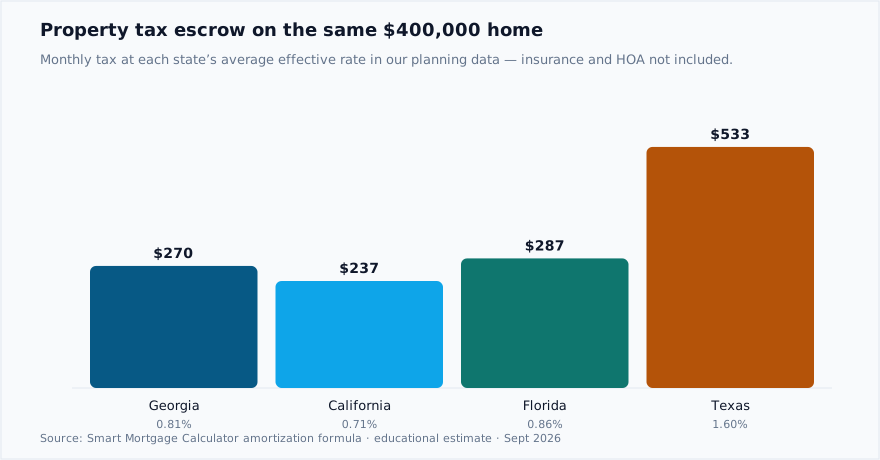
Worked comparison: a $400,000 purchase with 20% down at the same interest rate. At a 0.6% effective tax rate, taxes are about $200/month. At 2.0%, taxes are about $667/month — a $467 gap equivalent to a very large rate increase on the same loan balance.
What gets under-counted (and why escrow shocks happen)
The payment I approved in a hypothetical underwriting is not the payment two years later if taxes and insurance reprice. Lenders collect those into escrow; when premiums or assessments jump, the monthly payment can rise even if the note rate never changed. I budget a cushion. I do not treat the first escrow estimate as a personality.
- Property taxes after reassessment or homestead changes.
- Homeowners insurance shopping — listings often show last year’s premium.
- HOA or condo fees and special assessments (lenders often count these in housing DTI).
- Maintenance reserves (a common planning range is near 1% of home value per year — big roof/HVAC years hide inside that average).
- Closing costs (typically about 2–5% of the loan) and prepaid escrow at closing — separate from the down payment.
- Higher utilities than rent, commuting costs, and child care changes.
- An emergency fund so a surprise expense does not jeopardize the mortgage.
Georgia: approachable prices, still stress-test PITI
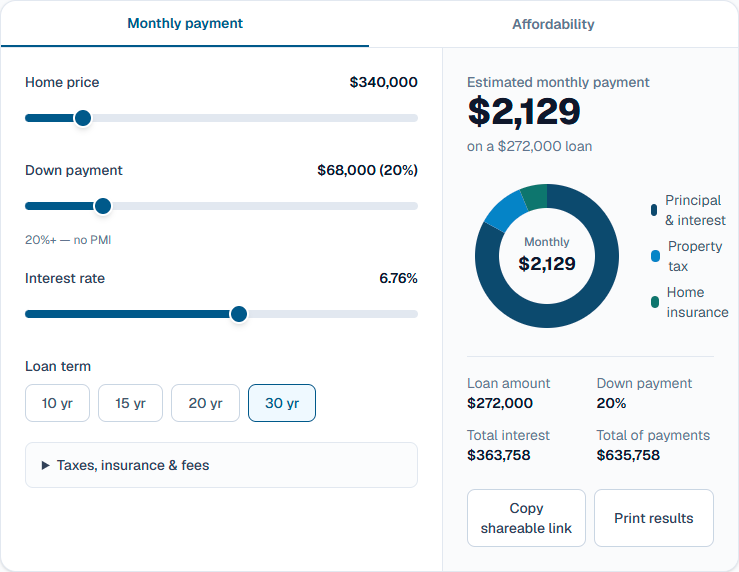
Georgia remains more approachable than coastal high-cost markets, with a statewide median near $340,000 and an effective property tax rate around 0.81% in our planning data. On that median with 20% down at a 6.75% 30-year rate, principal and interest are only part of the story: taxes add roughly $230/month and insurance about $130/month before PMI or HOA. Atlanta metro prices run well above the statewide median — I say that as someone who does not pretend Franklin is Buckhead. File for homestead exemption after you close as a primary resident when eligible, compare insurance quotes (roofs, claims history, and county matter), and explore Georgia Dream / DCA assistance if you are a first-time buyer — verify current caps on official sites. First-time cash-to-close steps live in our down payment and closing-cost guide. Run the Georgia mortgage calculator. The screenshot above is my own tool on a median-style run, not a listing photo I licensed.
Texas: no state income tax, high escrow
Texas attracts buyers with job growth and no state income tax, but I will not let anyone treat that as a cheap housing payment. Property taxes and homeowners insurance are a bigger slice than in Heard County. On a $350,000 median at about 1.60% effective tax, taxes alone add roughly $467/month; wind and hail risk push insurance — I budget on the order of $200/month statewide, knowing coastal and hail-prone counties run higher. Homestead exemptions can lower the bill after you close. I look at total monthly cost, not price per square foot. ARM usage can be higher when payments stretch — I stress-test with the ARM calculator. If you refinance later, Texas homestead and cash-out rules are specialized. Open the Texas calculator.
Florida: insurance is the wild card
Florida insurance — not just the mortgage rate — often determines whether a home fits. I learned that while wiring state defaults, not by buying a condo in Miami. Statewide planning data puts typical homeowners insurance near $2,400/year, but coastal counties can cost significantly more. Wind mitigation, roof age, and flood-zone placement change quotes by thousands. I would get an insurance estimate before I offered. Taxes near 0.86% still matter, but insurance is where budgets break. Budget flood coverage if you are in or near a FEMA flood zone, higher windstorm deductibles on coastal policies, and condo HOA fees that may include master insurance. FHA and VA remain common, but condo project approvals trigger overlays. Use the Florida calculator.
California: high prices, Prop 13, Mello-Roos
California's median sits among the highest in the nation (near $770,000 in our data), so affordability is as much about income, down payment, and loan product as interest rates. I do not pretend a Heard County payment intuition works in the Bay Area. Effective property tax averages about 0.71% thanks in part to Proposition 13 — a moderate rate on a high base still runs hundreds per month. Mello-Roos, HOA dues, and earthquake coverage can add more. Wildfire-exposed areas may see insurance availability and price pressure. I would expand search radius inland and through the Central Valley, look at CalHFA first-time programs if you qualify, and confirm FHA and conforming county limits before assuming a low-down product works on a high list price. Run the California calculator and the ARM stress test.
Shopping levers that protect affordability
Affordability is not only about picking a cheaper house. Better loan terms raise the price I can buy without raising the payment. That is why shopping belongs in an affordability article:
- Shop 3–5 Loan Estimates the same day so you are not stuck with one lender's overlay or pricing — best-rate guide.
- Ask about seller concessions or a temporary 2-1 buydown when markets are soft — concessions and cash to close.
- Improve credit before applying; even one pricing tier can free hundreds of monthly capacity — credit prep guide.
- If VA-eligible, model residual income and funding-fee scenarios in the VA calculator; disability-related funding-fee exemptions are sometimes under-claimed.
- Verify county FHA limits before assuming FHA works on a high-priced listing — FHA vs conventional.
Run your numbers
I use the home affordability calculator to work backward from income, then I open the mortgage calculator with the state's tax and insurance defaults — Georgia, Texas, Florida, California, or another state from the home page. I replace defaults with quotes and tax bills from the actual property. I target a payment below the maximum so there is breathing room. Estimates on this site are educational, not loan offers — confirm with a licensed lender and the county assessor. I will keep the Georgia screenshot honest. I will not sign your note.
FAQs
Should I buy at the 36% back-end maximum?
I would not. Lenders use gross income; you live on net. Insurance and taxes reprice after closing. On $9,000 gross, 28% is $2,520 of housing — treat that as a ceiling to stay under, not a target.
Why does the same income buy less house in Texas than in Georgia?
Escrow. When I held a $400,000 price still, the tax line was about $270/month in Georgia versus $533 in Texas at our planning rates. Same rate, same price, different house you can actually carry.
Do HOA dues count toward the 28%?
Usually yes — lenders often include HOA/condo fees in housing DTI (PITIA). A $400 HOA on a Florida condo can crowd out as much purchase price as a large rate increase. Put it in the calculator.
Is the 28/36 rule an FHA rule?
It is a common starting point, not a law. FHA and conventional automated underwriting can stretch with compensating factors. Stretching is how payment shock happens when escrow adjusts. Stay near 28/36 unless you have a written reason not to.
Keep reading
ARM vs. Fixed-Rate Mortgage: Stress-Test the Reset Before You Take the Teaser
I built the ARM calculator because teasers look like a cheat code until you recast the remaining balance at the cap.
How Mortgage Amortization Works: Why Year 1 Is Almost All Interest
I keep the first-month split on the wall: $1,688 interest and $258 principal on a $300,000 loan. That is amortization, not a trick.
This article is for general educational purposes only and is not financial advice. Rates and figures are indicative and may change. Consult a licensed mortgage professional about your situation. See our disclaimer.