Should You Refinance in 2026? Break-Even, Recast & State Costs
By Michael Hubbard, Founder & editor · Published May 30, 2026 · Updated September 11, 2026 · 9 min read
I built a refinance calculator because “rates dropped a little” is not a decision. Refinancing replaces the current mortgage with a new one — usually to lower the rate, shorten the term, switch an ARM to fixed, drop PMI/MIP, or tap equity. Recasting is a different tool: apply a large principal payment and re-amortize the remaining balance over the remaining term at the same rate. The question I actually ask is not “can I get a lower rate?” It is “will I stay long enough to come out ahead on closing costs and lifetime interest — or would a recast do the job cheaper?” Break-even math is nationwide. Title, transfer taxes, and some tangible net benefit laws are local. I keep both in the same article so I stop answering half the question.
The break-even method
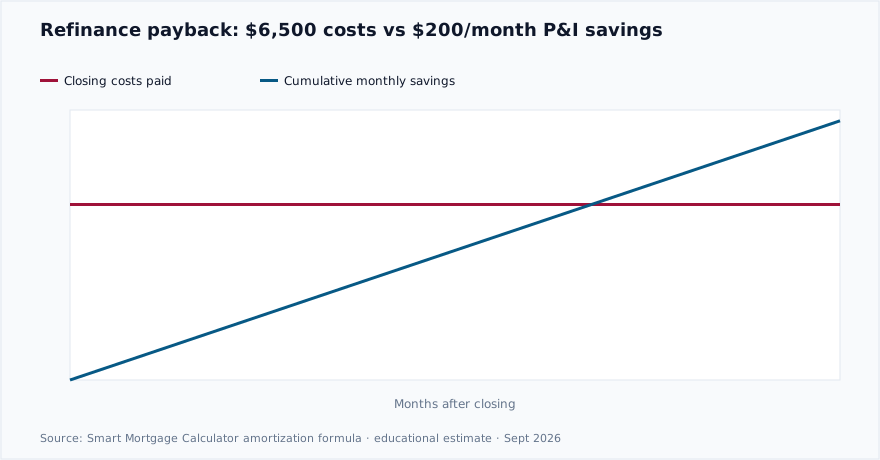
Refinancing has closing costs, typically about 2–5% of the loan unless I take a lender credit for a higher rate. I divide total costs by monthly P&I savings for break-even months. If the new loan saves $200 a month and costs $5,000 to close, I break even in 25 months. Stay longer than that and payment savings look profitable — then I still check whether restarting a 30-year term added more interest than I saved. That second check is why I put lifetime interest next to the pretty payback chart.
- Add all refinance costs you will not roll into the loan (or include rolled costs as higher balance).
- Divide by monthly P&I savings for crude break-even months.
- Compare remaining interest on the old loan vs total interest on the new path — especially if you restart a 30-year term.
- Stress-test selling in year two or three; if you move before break-even, skip the refinance.
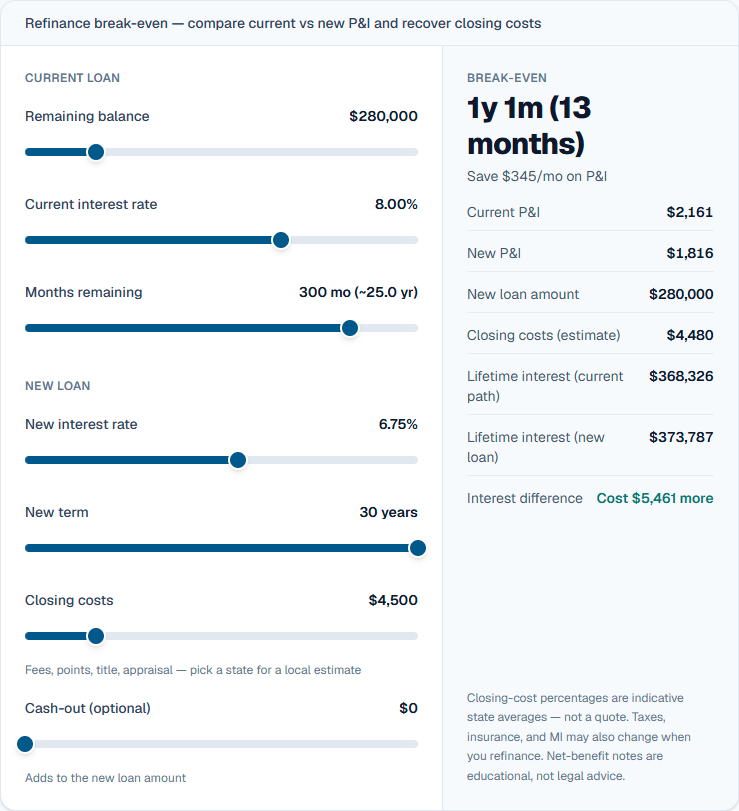
Worked pattern I keep: $6,000 costs / $150 monthly savings ≈ 40 months. If I will move in 24 months, I walk away — or I look at a shorter-cost refinance with lender credits (higher rate) if cash-flow relief is urgent. Suppose I owe $280,000 at a higher legacy rate with 300 months left, and I am offered a new lower rate on a fresh 30-year with $6,500 in closing costs. Monthly P&I savings might look attractive, but lifetime interest on the longer clock can shrink the win. I plug the same inputs into the refinance break-even calculator because I do not trust myself to do that arithmetic on a napkin while I am excited.
What usually shows up in refinance costs
- Origination / underwriting / processing fees (shoppable).
- Appraisal (unless waived) and credit report.
- Title search and lender's title insurance — premiums often follow state filings or promulgated rates.
- Recording fees and, in some jurisdictions, mortgage or intangibles taxes.
- Prepaid interest and refreshed escrow for taxes and insurance.
- Discount points or, conversely, lender credits.
Why the same refinance costs more in some states
The amortization math is the same in every state; what changes is the fee stack. Title insurance pricing models differ: filed rates, promulgated rates, or competitive markets. Transfer and mortgage taxes can be material in parts of New York, Florida, and other jurisdictions. Recording fees are minor alone but add up. High-tax, high-insurance states also raise cash to close when escrow is recalculated — even if lender fees look identical on a Loan Estimate. I compare a refinance on a Texas, Florida, California, or New York payment context, then I plug costs into the break-even calculator. Georgia is not magically cheap on title. It is just the county I can see out the window.
Tangible net benefit and anti-churning
Several states require lenders to document that a refinance provides a tangible net benefit to the borrower, or they restrict repeated refinances within short windows (anti-churning). Examples commonly discussed by compliance teams include Alaska, Arkansas, California, Florida, Massachusetts, and others — lists and tests change, so treat this as a prompt to ask your loan officer, not as a complete legal catalog. The practical effect: a tiny rate improvement with high fees may be unapprovable even if you would personally accept it. Streamlined FHA and VA refinances follow federal program rules, but local title practice and fees still shape cash to close.
Recast vs refinance
When I receive a lump-sum thought experiment — bonus, inheritance, sale of another property — two moves show up: refinance to a lower rate, or recast the existing loan. Recasting applies a large principal payment and re-amortizes the remaining balance over the remaining term at the same interest rate, usually for a modest administrative fee. I had to learn that recast is not a mini-refinance. Same rate. Remaining term. Different payment.
- Recast: you make a substantial principal payment (servicers often set minimums such as $5,000+); the servicer re-calculates monthly P&I using the same rate and remaining term; your payment drops; your rate does not. Fees are typically a few hundred dollars. Not every loan or investor permits recasts — ask your servicer in writing.
- Refinance: new interest rate and (usually) new Loan Estimate fees; chance to shorten or lengthen term, switch ARM to fixed, or change loan type (for example FHA to conventional to drop MIP); possible to cash out or remove PMI when equity supports it. Costs commonly run about 2–5% of the loan unless offset by lender credits.
| Move after a $40,000 lump sum | New P&I | Rate | Typical friction |
|---|---|---|---|
| Do nothing (keep $320,000 balance) | $2,211 | 6.75% unchanged | No fee; payment stays high |
| Recast to $280,000 remaining | $1,935 | 6.75% unchanged | Admin fee; must be allowed by investor/servicer |
| Refinance $280,000 to a new 30-year | Depends on new rate | New note; term often restarts | Often ~2–5% of loan unless lender credits |
Recasting wins when you already have a strong rate, you just want a lower payment after a lump sum, and your servicer offers recast. In that $320,000 example, the recast dropped P&I by $276/month without paying thousands in title and points. Refinancing wins when your current rate is meaningfully higher than market quotes, you need to change loan type (MIP escape), or you want cash-out. A recast alone may not cancel PMI; you still must meet the servicer's LTV cancellation process — PMI guide. FHA annual MIP duration follows HUD rules, not recast mythology. If the goal is exiting FHA MIP, a conventional refinance after sufficient equity usually matters more than a recast.
Good reasons to refinance
- You can lower your rate enough to outlast the break-even after all costs.
- You want to switch from an adjustable to a fixed rate for payment certainty.
- You want to shorten the term and can afford the higher payment.
- You have built enough equity to drop PMI/MIP via a conventional rate-and-term refinance.
- You qualify for a VA IRRRL or FHA streamline where fee structure and residual rules fit (verify current VA/HUD guidance).
When not to refinance
- You may sell or move before recovering closing costs.
- The payment drop comes only from stretching the term while total interest rises.
- Cash-out pricing is worse than a HELOC for a short-term project.
- You are chasing a teaser ARM without modeling the post-reset payment — use the ARM calculator.
- A simple recast would lower the payment after a lump sum without new rate risk.
Rate-and-term vs cash-out
Rate-and-term refinances change rate, term, or loan type. Cash-out adds to the balance and often prices slightly worse with stricter LTV caps. If you need cash for a defined project, compare cash-out against a HELOC so you do not put your entire first mortgage rate at risk for a short need — I ran a $50,000 kitchen example in cash-out vs HELOC. Cash-out typically allows less LTV and may face stricter net-benefit scrutiny. Texas homestead cash-out has specialized constitutional constraints — use a Texas specialist.
Streamlined FHA and VA refinances
FHA streamline and VA IRRRL products follow federal frameworks that can reduce documentation or appraisal needs when rules are met. Outcomes still feel local: title practices, state taxes, funding-fee treatment on some VA cash-out (IRRRL is usually rate/term), and residual/MIP carryover math. Always confirm current HUD/VA eligibility — streamline does not mean “zero diligence.”
Shop the refinance like a purchase
- Collect 3–5 Loan Estimates the same day with the same loan amount, points, and lock period — shopping playbook.
- Negotiate fees using competing LEs; refinance origination fees are often movable.
- Ask about float-downs if you lock before the closing package is final.
- Confirm appraisal waiver eligibility — waivers save money when offered, but you cannot assume one.
- Get your servicer's written recast policy, minimum principal amount, fee, and timeline before you pay for a refinance appraisal.
Run the numbers in the refinance calculator before I would pay an application fee. Confirm state net-benefit rules, recast eligibility, and current VA/HUD streamline criteria with a licensed lender and the servicer. Educational estimates only. The screenshot in this article is our widget, not a closing package.
FAQs
Is a lower payment always a win?
No. Restarting a 30-year term can raise lifetime interest even when the note rate drops. In the refinance calculator, a short break-even can sit next to a worse interest total. Check both.
When does a recast beat a refinance?
When you already like your rate and you have a lump sum. My $40,000 principal / 300 months remaining example cut P&I from $2,211 to $1,935 at the same 6.75%. That is a $276/month drop without a new Loan Estimate — if the servicer allows recast.
Will a refinance drop FHA MIP?
A conventional refinance can, once equity and credit support PMI (or 20% down equivalent). An FHA streamline usually keeps you in FHA MIP rules. Recasting an FHA loan does not rewrite HUD’s duration clock.
Do I need a tangible net benefit letter?
In some states, yes — lenders must document that the refinance helps you, or they restrict rapid repeat refinances. Ask your loan officer before you pay for an appraisal on a tiny rate improvement with fat fees.
Keep reading
Cash-Out Refinance vs. HELOC: Don’t Reprice the Cheap First Mortgage
Cash-out made the monthly bill look cheaper in my $50,000 test. After five years it left more debt. That is the comparison I actually ran.
ARM vs. Fixed-Rate Mortgage: Stress-Test the Reset Before You Take the Teaser
I built the ARM calculator because teasers look like a cheat code until you recast the remaining balance at the cap.
This article is for general educational purposes only and is not financial advice. Rates and figures are indicative and may change. Consult a licensed mortgage professional about your situation. See our disclaimer.