Cash-Out Refinance vs. HELOC: Don’t Reprice the Cheap First Mortgage
By Michael Hubbard, Founder & editor · Published September 11, 2026 · 10 min read
I keep a $50,000 kitchen-and-roof file next to the refinance calculator because cash-out and a HELOC get sold as the same product: “use your equity.” They are not the same product. Cash-out replaces the first mortgage. A HELOC (or a closed-end home equity loan) usually sits behind it. If you already like the rate on the first, cash-out is how you volunteer to reprice the cheap debt in order to borrow the new slice. I am Michael Hubbard. I build the calculators from Heard County, Georgia. I do not originate HELOCs. I do run the payment math until the cheaper-looking monthly stops lying.
The setup: $400,000 house, $240,000 remaining on a 6.75% first with 25 years left, and a defined $50,000 project. I am not forecasting your kitchen. I am asking what happens to the first mortgage if you fold that $50,000 into a new 30-year note versus leaving the first alone. The break-even article — should you refinance in 2026 — is about replacing a rate. This page is about whether the cash need should be allowed to touch that rate at all.
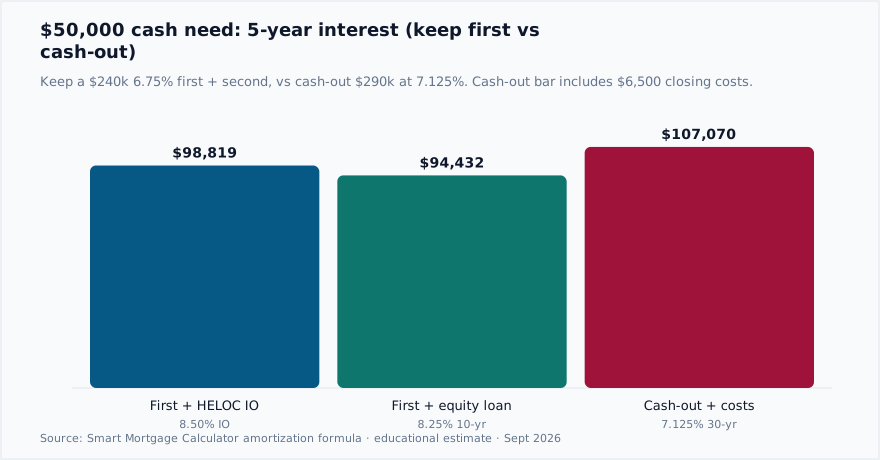
Three ways to fund $50,000 on the same house
| Path | Monthly P&I (year 1) | Interest in first 5 years | Debt still owed after 5 years |
|---|---|---|---|
| Keep 6.75% first + HELOC IO | $2,012 ($1,658 + $354) | About $99,000 | About $268,000 if the HELOC is still drawn |
| Keep first + 10-year equity loan | $2,271 ($1,658 + $613) | About $94,000 | About $248,000 |
| Cash-out $290k at 7.125% 30-year | $1,954 | About $101,000 + $6,500 costs | About $273,000 |
Why the cash-out payment looks cheaper
Two tricks stack. First, I stretched 25 remaining years into a fresh 30. Stretching always cuts the required payment on the same balance; that is amortization, not a gift — how amortization works. Second, the HELOC payment sits on top of the first. Cash-out hides the new $50,000 inside one bill. The first-month 6.75% payment on $240,000 with 300 months left is about $1,658. The cash-out 7.125% payment on $290,000 for 360 months is about $1,954. You borrowed $50,000 more, restarted the clock, and the bill still fell versus first-plus-HELOC. That is the sales slide. After 60 months the cash-out balance is about $273,300. The kept first is about $218,100. If the interest-only HELOC is still fully drawn, total debt is about $268,100 — close, and you never paid the $6,500 title-and-origination stack. If the second is a 10-year equity loan, the second has also paid down to about $30,100. Total debt about $248,200. That $25,000 gap versus cash-out is the project I actually care about.
Lifetime interest on the cash-out note is about $413,000 because I restarted 30 years on $290,000. Lifetime interest left on the first alone is about $257,000. Those two figures are not a fair headline fight — the first does not include the $50,000. Fair is the five-year window plus remaining balances, which is why the table leads. I still publish the lifetime number so nobody “saves” their way into a 360-month clock they did not mean to reopen.
When cash-out is the tool I would actually use
If the first is already a high rate you planned to refinance anyway, folding in cash can be one closing instead of two. I reran the same balances with an 8.00% first and a 6.75% cash-out on $290,000. The old first was about $1,852 P&I. The cash-out was about $1,881 — almost the same bill, a rate drop, and $50,000 at the table. That is a different personality than poisoning a 6.75% first. I would still check lifetime interest and stay-horizon in the refinance calculator, because restarting 30 years on a larger balance can erase the rate win. If you were already doing rate-and-term, cash-out is a pricing and LTV question on a loan you were replacing. It is not an excuse to skip break-even.
- You need one payment, one servicer, and you will keep the house past refinance break-even — break-even and recast.
- The cash is a long-horizon use (permanent addition, not a six-month bridge) and you accept a larger first lien.
- Cash-out is how you drop PMI or change loan type while you are already in underwriting. Do not invent a cash-out just to chase a teaser ARM — stress the reset.
When I would keep the first and add a second
If the first is a rate I would be sad to lose, I want the new money in a second lien I can pay off without refinancing the cheap debt. A closed-end home equity loan is the version I can amortize in our engine: fixed payment, known payoff. A HELOC is usually variable and often interest-only in the draw period. I modeled 8.50% interest-only ($354 a month on $50,000) as a budget test, not a quote. Your index-plus-margin will move. That is the HELOC’s honest risk: the $354 is not a 30-year promise. I would size the draw to a project with an end date, then amortize or repay it so I am not carrying a standing second into year ten “because the rate might drop.”
- Write down the first’s rate, remaining term, and whether you would refinance it tomorrow with zero cash-out. If the answer is no, protect it.
- Price a cash-out Loan Estimate and a HELOC or home-equity-loan estimate the same week — same $50,000 net cash, not the same headline rate.
- Add five years of interest plus remaining balances, not just month-1 P&I. Use the mortgage calculator for the first and the amortizing second; treat HELOC interest-only as balance × monthly rate.
- Ask how the second is secured, whether it is variable, and what payment is due when the draw period ends. A reset on a second is still a reset.
- Confirm cash-out seasoning, max LTV, and occupancy rules with a licensed lender. Texas homestead cash-out is its own constitutional conversation — I will not fake a Texas closing from Franklin.
What this site will and will not pretend to calculate
Our refinance tool can add optional cash-out to a new first and show break-even versus the current note. It does not originate a HELOC, forecast SOFR, or apply a lender’s cash-out LLPA. The 7.125% in this article is an educational step-up off our 6.75% default to stand in for worse cash-out pricing — not a lock. If a loan officer’s cash-out is only 0.125 better or worse than rate-and-term, swap that rate into the same worksheet. The structure of the comparison does not change: you are either replacing the first or stacking on top of it.
Run the cash-out path in the refinance calculator. Run the kept first in the payment calculator. Confirm HELOC index, margin, floor, ceiling, and draw-period payment with the bank that would record the second. Educational estimates, not a commitment to lend. Methodology: how we calculate.
FAQs
Is a HELOC always cheaper than cash-out?
No. If you were going to refinance the first anyway, one cash-out closing can beat two sets of fees. If you like the first’s rate and the cash need is short, a second usually poisons less of the cheap balance. Run both.
Does cash-out hurt my rate even if I only need a little cash?
Often yes: cash-out pricing and max LTV are typically worse than rate-and-term on the whole loan, not just the extra dollars. That is why a small kitchen can reprice a large first.
What if I pay the HELOC off in two years?
Then the five-year table overstates the second’s interest, which makes keeping the first look even better versus cash-out. I would still check variable-rate shock during those two years.
Can I recast instead of cash-out if I already have the cash?
Recast is for lowering the payment on the current note after you apply a lump sum you already own. It does not fund a kitchen. If the money is still in the house as equity, you need a new draw — cash-out, HELOC, or a home equity loan — recast vs refinance.
Keep reading
Should You Refinance in 2026? Break-Even, Recast & State Costs
I built the break-even widget because “the rate dropped” is not a decision — 32.5 months and a recast comparison are.
ARM vs. Fixed-Rate Mortgage: Stress-Test the Reset Before You Take the Teaser
I built the ARM calculator because teasers look like a cheat code until you recast the remaining balance at the cap.
This article is for general educational purposes only and is not financial advice. Rates and figures are indicative and may change. Consult a licensed mortgage professional about your situation. See our disclaimer.