ARM vs. Fixed-Rate Mortgage: Stress-Test the Reset Before You Take the Teaser
By Michael Hubbard, Founder & editor · Published September 11, 2026 · 9 min read
I did not add an ARM calculator because I wanted another product label. I added it because a 5/1 teaser kept showing up in the same conversations as “I can’t quite make the 30-year fixed.” The first time I modeled that on a $350,000 balance, the intro 6.00% payment was $2,098 of principal and interest. The 30-year fixed at our 6.75% default was $2,270. That $172 gap looks like free money for five years. Then I recast the remaining balance after 60 months at an 11% lifetime-cap-style rate over the leftover 25 years, and the payment jumped to about $3,192. I am Michael Hubbard. I build these tools from Heard County, Georgia. I am not selling you an ARM. I am showing you the reset I actually ran.
A 5/1 or 7/1 ARM is a 30-year loan with a fixed introductory rate, then periodic adjustments based on an index plus a margin, subject to caps. The intro rate is usually lower than a same-day 30-year fixed. That is the whole sales pitch. The whole risk is what happens if you still own the loan when the pitch expires. I treat ARMs as a horizon tool, not a personality type.
The $350,000 run I keep next to the ARM slider
| Path | Monthly P&I | After 60 months |
|---|---|---|
| 30-year fixed at 6.75% | $2,270 | Balance about $328,600; payment unchanged |
| 5/1 ARM intro at 6.00% | $2,098 | Balance about $325,700; $172/month cheaper so far |
| ARM reset at 8% (remaining term) | $2,514 | Higher than the fixed you skipped |
| ARM reset at 11% (cap-style) | $3,192 | About $1,094 above the intro payment |
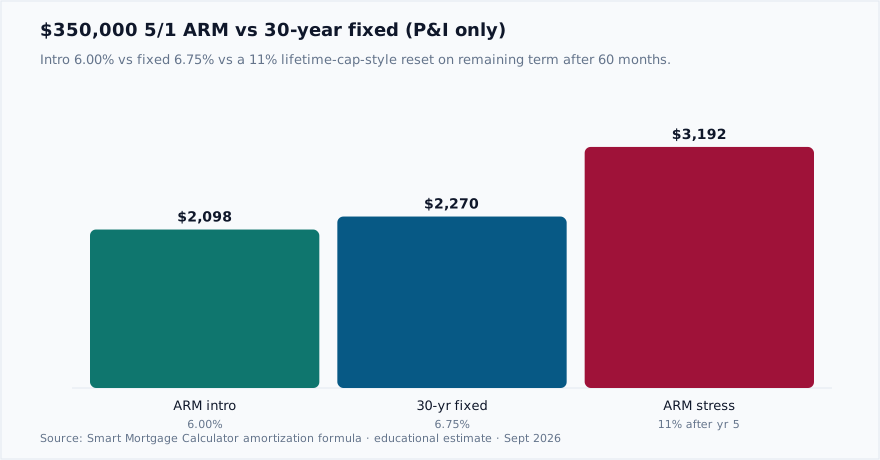
I also ran the first-adjustment cap as a 2-point jump off 6.00%, which is how a 2/2/5 file behaves if the index has ripped. That is an 8% remaining-term recast: about $2,514 P&I on the leftover $325,690. That is already $244 above the 6.75% fixed I could have locked in month 1. The 11% lifetime-cap-style case ($3,192) is the ugly cousin. I keep both on the table because borrowers argue about which cap will “probably” bind. I do not forecast the index. I budget the contract.
Caps, margin, and why two 5/1s are not the same loan
A common cap structure is written 5/2/5 or 2/2/5: how far the rate can jump at the first adjustment, at later adjustments, and over the life of the loan. The margin is added to the index (often a Treasury or SOFR flavor). I ask for those five numbers in writing: index, margin, initial cap, periodic cap, lifetime cap. Two ARMs with the same teaser can be different animals after year five. Our ARM calculator uses a simplified stress rate you choose. It is not a forecast of next year’s SOFR. It is a budget test.
- Set the stress rate near the lifetime cap from the Loan Estimate, not a hopeful “rates will be lower.”
- Confirm whether the first adjustment cap is 2 points or 5 — that single digit changes year-six payment more than a 0.125% teaser difference.
- Ask what happens if you do not refinance: some files only work if a future lock is assumed. I do not underwrite hope.
When I would actually take the ARM
I would take a 5/1 if I had a dated plan to sell or refinance before the first reset, and the 5-year P&I savings beat the extra friction of a refinance — or if I could pay the stress payment without rearranging my life. Military PCS, a known job window, a house I already expect to outgrow: those are horizon stories. “The payment only fits if the teaser lasts forever” is not a horizon story. That is a price problem. I said the same thing in the 15- versus 30-year guide when an ARM tried to impersonate a cheaper 15-year.
In high-cost markets I see ARM usage rise because the fixed payment will not qualify. California is where I send people to the ARM slider for that reason, not because I think an ARM is “better” there. In Heard County I rarely need a teaser to make a median-style payment work. Location changes the temptation. It does not change the recast math.
Qualification still uses a payment — whose?
Lenders do not all qualify ARMs on the intro rate. Some use a fully indexed or qualifying rate that is higher than the teaser. I do not guess which overlay your shop uses. I ask. If the file only clears on the teaser, I treat that as a warning, not a win. DTI on a payment you cannot survive after reset is how people get stuck. Pair this with how much house I can actually carry — escrow still sits on top of either product.
How I compare quotes on the same day
- Get a 30-year fixed Loan Estimate and a 5/1 or 7/1 ARM LE the same day, same points assumption, same loan amount.
- Write down index, margin, and all three caps. If they are missing, the LE is incomplete.
- Run intro P&I versus stress P&I in the ARM calculator.
- Add five years of intro savings. Ask whether that pile is larger than a refinance cost if you exit before reset — refinance break-even.
- If you cannot pay the stress number, I want the fixed — or a cheaper house.
Refinancing out is not a plan unless the math is a plan
Plenty of ARM borrowers intend to refinance before reset. I intend lots of things. Rates can be higher in year five than in year zero. Credit can be worse. The house can appraise light. If the exit plan is “I will refinance,” I still want the stress payment to be livable. Otherwise the ARM is a balloon you have not named.
Confirm caps and qualifying rate with a licensed lender. Formula notes: how we calculate. Related shopping: same-day Loan Estimates.
FAQs
Is a 7/1 safer than a 5/1?
It buys two more years of intro rate, not immunity. I still stress the first reset. If you might stay eight years, a 7/1 can be the difference between exiting in the intro window and eating a reset. If you might stay twenty, I want the fixed.
Does your calculator recast the remaining balance at reset?
The on-page ARM stress slider compares intro P&I to a higher rate on the starting balance as a budget test. The $3,192 figure in this article is the stricter month-60 recast I ran on the remaining $325,690 over 25 years at 11%. Both are educational. Your note uses the caps on your LE.
Can I pay extra principal on an ARM?
Often yes, same as a fixed — confirm prepayment language. Extra principal lowers the balance that will recast at reset, which is one of the few ARM defenses I like. See extra principal.
Should I take an ARM to afford more house?
I would not. If the house only fits on a teaser, the house does not fit. Buy less, put more down, or wait. Stretching on an ARM is how the reset becomes a forced sale.
Keep reading
VA Loan Entitlement, Residual Income & Funding Fees (2026)
I wired VA residual tables into the calculator from Franklin — South family-of-four is $1,003, and DTI-only thinking still fails files.
FHA vs. Conventional Loans: Limits, MIP Duration & Which Fits
I built the FHA calculator to stop treating MIP as a monthly footnote — duration, county limits, and overlays decide the real cost.
This article is for general educational purposes only and is not financial advice. Rates and figures are indicative and may change. Consult a licensed mortgage professional about your situation. See our disclaimer.