How Mortgage Amortization Works: Why Year 1 Is Almost All Interest
By Michael Hubbard, Founder & editor · Published September 11, 2026 · 8 min read
The first month on a $300,000 30-year at 6.75% still startles me, and I wrote the function. Principal and interest is $1,946. Of that, about $1,688 is interest and about $258 is principal. You are not being cheated. You are renting the whole remaining balance for 30 days at the note rate, then applying whatever is left to the balance. Next month the balance is slightly smaller, so interest is slightly smaller, so principal is slightly larger. That snowball is amortization. I published the formula on how we calculate because I got tired of black-box payment apps.
People email as if the early years are a scam. They are front-loaded because the loan is largest at the start. A 15-year note front-loads less interest for a simpler reason: you send a bigger payment, so more of each month hits principal from day one. I ran that comparison in the 15- versus 30-year guide. This page is the plumbing underneath both.
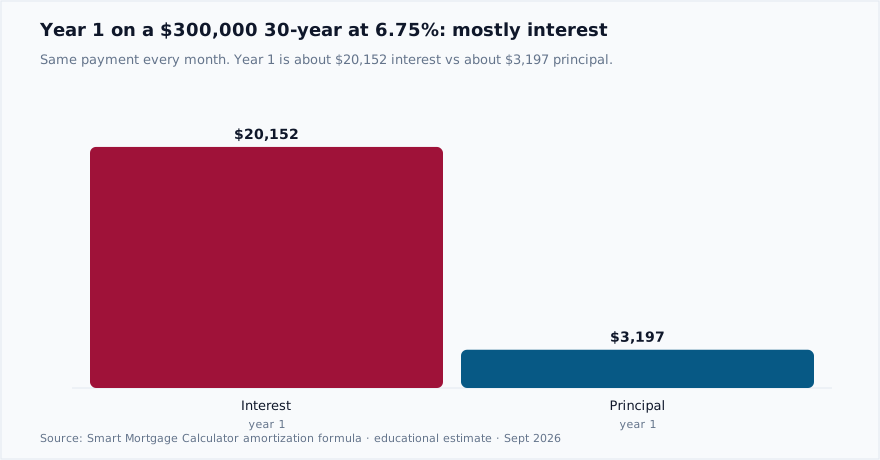
A 6.75% annual rate on $300,000 is $20,250 if you pretend the balance never falls. My year-1 interest was $20,152 because each month’s balance was slightly smaller. The gap is small in year 1 and larger later. That is the whole reason I refuse napkin annualization when someone asks “so I pay 6.75% of the house every year, right?” No. You pay 6.75% of whatever principal is still outstanding, monthly.
The formula I actually ship
Monthly interest is remaining balance times the annual rate divided by 12. The principal piece is the required payment minus that interest (or whatever is left if the loan is almost gone). The payment itself comes from the standard amortizing formula — the one that holds P&I constant while the mix changes. If the rate is zero, we just divide the balance by the number of months. I did not invent this. I did implement it, and I test it whenever I change a slider.
- Compute the constant P&I payment from loan, rate, and term.
- Each month: interest = balance × monthly rate.
- Principal = payment − interest (capped at remaining balance).
- New balance = old balance − principal.
- Repeat until the balance is gone — 360 times on a 30-year, unless you pay extra.
Year 1 versus the story in your head
| Checkpoint | Interest paid so far | Balance still owed |
|---|---|---|
| After month 1 | About $1,688 | About $299,742 |
| After year 1 | About $20,152 | About $296,803 |
| After year 5 | About $98,375 | About $281,627 |
| After year 10 | About $189,398 | About $255,903 |
By year 10 in that same $300,000 run I had paid about $189,000 of interest and still owed about $256,000. The payment never changed. The mix did. I walked the schedule looking for the month principal finally exceeds interest: month 238 on this rate and term — late in year 19 — when the remaining balance is about $172,000. If you only look at the monthly total, you miss the entire plot. Open the schedule on the mortgage calculator and scroll until the principal column overtakes interest. That month is why extra principal early is leverage: you delete payments that still live on the interest-heavy side of the book.
Why extra principal in year 1 is not wasted
I used to half-believe the myth that extra principal early “doesn’t matter” because the loan is all interest anyway. The opposite is true. An extra $200 this month never pays this month’s interest — interest is already determined by the balance. It cuts the balance that next month’s interest is calculated on. Skip a slice of the back of the schedule, where the remaining term would have kept charging rent on that $200. The extra-principal guide is the payoff-month version of this idea. Here I only need you to see the mechanism.
What the schedule on our calculator is for
I put a year-by-year and month-by-month schedule on the main mortgage calculator so you can watch the mix flip. Early years: interest bar is the tall one. Later years: principal wins. If you change the rate or term, the crossover year moves. A 15-year at 6.25% on the same $300,000 sends $2,572 a month, so principal gets a bigger bite immediately. That is not magic. That is a larger payment attacking the same kind of formula.
- Taxes, insurance, PMI, and HOA are not in the amortization of the note. They are escrow (or you pay them outside). PITI can rise when insurance reprices even if the P&I line never changes — affordability and escrow.
- PMI in our conventional model is a percent of the original loan until 20% down equivalent, not a third column inside amortization — PMI removal.
- ARMs recast the payment at reset on whatever balance is left. That is still amortization, just with a new rate and remaining term — ARM vs fixed.
Simple interest versus this schedule
Most closed-end home loans in the U.S. use this monthly amortizing structure, not daily simple interest like some HELOCs. If you pay 15 days late, you usually still owe the same monthly interest piece plus fees — you do not get a discount for paying on day 2. I mention that because people bring car-loan intuition to a mortgage and then argue with the PDF. Read your note. I still want you to confirm servicing with the people who own the loan. The last payment is almost never exactly $1,946 either: rounding and a leftover stub make the final month a cleanup. Our schedule caps principal at what is left. If a servicer PDF is off by a few dollars, that is usually rounding. If it is off by a whole payment, look for extra principal sitting in suspense — or a rate that is not the note rate.
Open the calculator, download or scroll the schedule, and stare at month 1. If the split makes you angry, good — now you know why extra principal and shorter terms exist. The PDF export on the main tool is the same formula as the on-page table; I use it when I want to mark the crossover month in the margin. Methodology: how we calculate.
FAQs
Does a larger down payment change the interest-versus-principal mix?
It changes the starting balance, so every month’s interest is smaller. The mix in month 1 is still mostly interest on a 30-year at mid-6% rates. You just borrowed less.
If I recast, does amortization restart?
Recast keeps the rate and remaining term, then computes a new lower payment on the new balance. The mix still starts interest-heavy relative to that new payment. Refinance can restart a 30-year clock entirely — refinance vs recast.
Why doesn’t 6.75% of $300,000 equal my year-1 interest?
Because the balance falls each month, and because 6.75% is annual. Year-1 interest in my run was about $20,152, not $20,250. Close, not identical. Use the schedule, not a napkin annualization.
Is interest tax-deductible because it’s front-loaded?
Deductibility depends on your filing situation and current tax law, not on how ugly month 1 looks. Ask a tax professional. I will not do your Schedule A from a calculator footer.
Keep reading
Extra Principal Payments vs. Biweekly Mortgages: What Actually Shortens the Loan
I ran +$100 and +$200 extra principal on the same $300,000 note. The calendar moved. The rate did not. That is the whole trick.
How Much Down Payment Do You Need? Closing Costs, Concessions & First-Time Paths
I do not treat 20% as a personality test. I treat it as the PMI cliff, then I stack closing costs and Georgia first-time paths on top.
This article is for general educational purposes only and is not financial advice. Rates and figures are indicative and may change. Consult a licensed mortgage professional about your situation. See our disclaimer.