VA Loan Entitlement, Residual Income & Funding Fees (2026)
By Michael Hubbard, Founder & editor · Published August 6, 2026 · Updated September 11, 2026 · 8 min read
I am not a VA lender and I will not pretend a Certificate of Eligibility is something I issue. I am the person who had to put residual-income charts, funding-fee percentages, and a $0-down path into a calculator without lying. VA-backed loans remain one of the strongest benefits for eligible service members, veterans, and surviving spouses: often $0 down, competitive pricing, no monthly PMI. The details that trip people up — the ones I hit while coding — are entitlement math, residual income (not just DTI), funding fees and disability exemptions, and how appraisals treat minimum property requirements. Confirm current VA circulars and lender overlays before you rely on any figure here.
Full vs partial entitlement and loan size
With full entitlement, VA typically does not set a maximum loan amount the way FHA does — lenders still underwrite ability to repay and may impose their own caps. With partial entitlement (another VA loan outstanding, or entitlement not fully restored), remaining guaranty often interacts with FHFA conforming county limits — commonly discussed against a 2026 baseline near about $832,750 in many counties. I always want a COE in the file before I would model “$0 down, any price.” Have the lender calculate remaining entitlement for the county. I will not guess yours from here.
Residual income by region and family size
VA underwriting emphasizes residual income: money left after shelter expense, debts, and taxes for day-to-day living. I had to store those charts by region and family size in our code. That is why two buyers with the same gross DTI can see different VA outcomes in different regions or household sizes. New debts after pre-approval eat residual first — I would freeze lifestyle financing until funded, especially on a tight South-region file like the one below.
| Family size | Northeast | Midwest | South | West |
|---|---|---|---|---|
| 1 | $450 | $441 | $441 | $491 |
| 2 | $755 | $738 | $738 | $823 |
| 3 | $909 | $889 | $889 | $990 |
| 4 | $1,025 | $1,003 | $1,003 | $1,117 |
| 5 | $1,062 | $1,039 | $1,039 | $1,158 |
I live in Franklin, Georgia — South region. A family of four here is measured against $1,003. The same household in California (West) is measured against $1,117. That $114 is not a cost-of-living guess I invented; it is the regional table. Do not borrow a friend’s Midwest residual result for a West Coast file.
A residual file that “looks fine” on DTI
Lenders still compute DTI. VA still wants residual. I walk tight files like this (illustrative, not a credit decision):
| Comfortable file | Tight file | |
|---|---|---|
| Net income after taxes | $5,400 | $5,100 |
| Proposed PITI | $2,450 | $2,700 |
| Other debts (car, student, cards) | $1,100 | $1,450 |
| Residual left | $1,850 | $950 |
| Vs $1,003 South / family of 4 | Clears by $847 | Short by $53 |
The tight file can still show an acceptable gross DTI if income is high enough before taxes. Residual is the leftover on a net-ish basis, and $53 under the chart is how VA denials happen on “fine” DTI. A new $80/month furniture account after pre-approval would have blown the comfortable file’s margin too. If you are close, shrinking the house payment (price, taxes, insurance) usually helps more than arguing the ratio.
- Higher residual requirements generally apply to larger households.
- Geographic residual tables differ — do not borrow a friend's Midwest residual result for a West Coast file.
- A residual income reduction of about 5% is sometimes available for certain borrowers living near their duty station — ask your loan officer whether you qualify under current VA rules.
- Taxes, insurance, and state veteran benefits that lower housing cost improve residual.
Funding fees, subsequent use, and disability exemptions
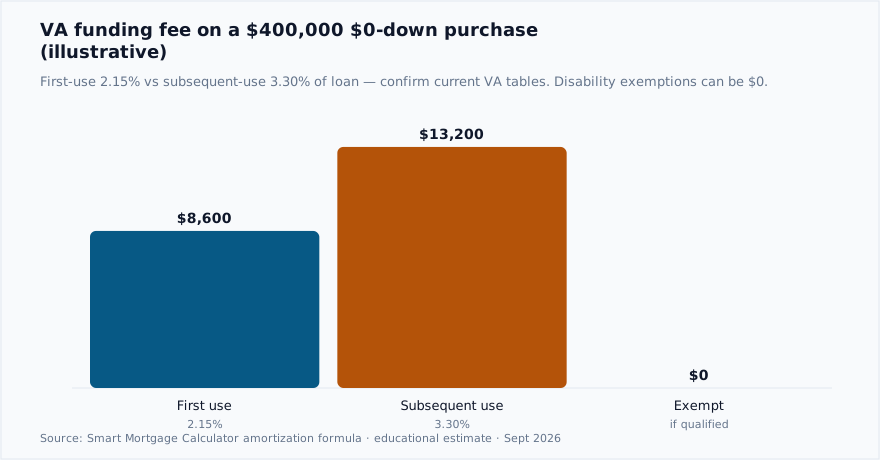
Most VA purchase and cash-out transactions include a funding fee that varies by first vs subsequent use and down payment. The fee is often financed into the loan. The expensive miss I keep repeating: veterans with qualifying service-connected disability ratings (and some other categories) may be exempt — yet exemptions get under-claimed when COE data or disability documentation is incomplete. Subsequent-use fees are higher than first-use in standard schedules. Restoring entitlement after selling a prior VA-financed home (and paying off that loan) can matter for the next purchase. Verify current fee tables on VA.gov. I am not going to memorize a circular that VA can update next month.
| Use / status | Fee rate (illustrative) | Dollars added to this loan |
|---|---|---|
| First-use purchase, $0 down | 2.15% | $8,600 |
| Subsequent-use purchase, $0 down | 3.30% | $13,200 |
| Qualifying exemption (e.g. disability) | 0% | $0 |
Entitlement restoration nuances
- Selling the home and repaying the VA loan typically frees entitlement for another use.
- Keeping a prior VA loan (for example, as a rental after PCS) usually ties up entitlement and can force partial-entitlement math.
- One-time restoration and refinance rules have specific paperwork paths — use a VA-experienced lender.
Appraisals: MPR vs cosmetics
VA appraisals enforce minimum property requirements focused on safety and soundness. I care about this because readers confuse “dated kitchen” with “fail.” Peeling paint in certain contexts, exposed wiring, or non-functional systems can become repair conditions; cosmetic kitchens often do not. Knowing MPR versus cosmetic issues is how I would keep a contract from turning into a repair scramble.
Seller concessions and local affordability
VA generally limits seller concessions (distinct from reasonable discount points in some reads of the rules) around about 4% of the reasonable value for certain closing costs — confirm with the lender. Local taxes, insurance, and state veteran property-tax benefits change residual income and payment comfort. I model scenarios in the VA calculator and a state mortgage calculator. Concession structure: down payment guide.
Shopping tips for VA borrowers
- Choose lenders who close VA weekly — overlays on credit and condos vary widely. If one shop declines, ask whether the issue is a VA guideline or a company overlay, then shop specialists — rate shopping and overlays.
- Bring COE and disability documentation early if you believe you are funding-fee exempt.
- Compare Loan Estimates including financed funding fee vs cash payment.
- Ask about IRRRL refinance later if rates drop — still run break-even math in the refinance calculator.
Related reading: down payment options and FHA vs conventional if you are comparing products. Verify entitlement, residual charts, and fees with VA resources and a licensed VA lender. I will keep the calculator honest. I will not underwrite the COE.
FAQs
Does VA set a maximum loan if I have full entitlement?
Typically VA does not cap you the way FHA county limits cap FHA. Lenders still underwrite ability to repay and may impose their own size caps. Partial entitlement is the trap: remaining guaranty often interacts with FHFA conforming county limits.
If my DTI is fine, can residual still deny the loan?
Yes. Residual is a separate test. In the South family-of-four example above, $950 leftover fails a $1,003 chart even when gross DTI looks passable. New debts after pre-approval hit residual first.
Should I pay the funding fee in cash?
Financing it raises the loan and the payment; paying cash preserves the balance. Run both in the VA calculator. If you may be exempt, fix the COE before you decide — a documented exemption is $0, not a cash-vs-finance debate.
Can I keep a prior VA loan as a rental and still buy $0 down?
Keeping the old loan usually ties up entitlement and can force partial-entitlement math plus a down payment on the next purchase. Restoration after selling and paying off is the cleaner path. Use a VA-experienced lender on the COE math — I will not guess your remaining guaranty.
Keep reading
ARM vs. Fixed-Rate Mortgage: Stress-Test the Reset Before You Take the Teaser
I built the ARM calculator because teasers look like a cheat code until you recast the remaining balance at the cap.
FHA vs. Conventional Loans: Limits, MIP Duration & Which Fits
I built the FHA calculator to stop treating MIP as a monthly footnote — duration, county limits, and overlays decide the real cost.
This article is for general educational purposes only and is not financial advice. Rates and figures are indicative and may change. Consult a licensed mortgage professional about your situation. See our disclaimer.