FHA vs. Conventional Loans: Limits, MIP Duration & Which Fits
By Michael Hubbard, Founder & editor · Published May 22, 2026 · Updated September 11, 2026 · 9 min read
I did not become an FHA expert by closing FHA loans. I became one by having to make the calculator refuse to pretend MIP is just “PMI with a different acronym.” Eligibility and MIP rules are national. The maximum loan and your tax/insurance escrow are local. Heard County, Georgia sits comfortably under the 2026 FHA floor; a coastal California listing can slam into the high-cost ceiling. I verify the current map on HUD sources before I trust any number in this piece. The figures below are educational 2026 planning references, not an approval.
Side-by-side snapshot
| FHA | Conventional | |
|---|---|---|
| Typical down payment | 3.5% at 580+ FICO; often 10% at 500–579 | About 3% for strong first-time files; 20% removes PMI |
| Credit flexibility | More forgiving minimums; overlays still bite | Pricing improves sharply through 680 / 720 / 760 bands |
| Mortgage insurance | Upfront MIP (often financed) plus annual MIP | PMI that you can usually request to cancel near 20% equity |
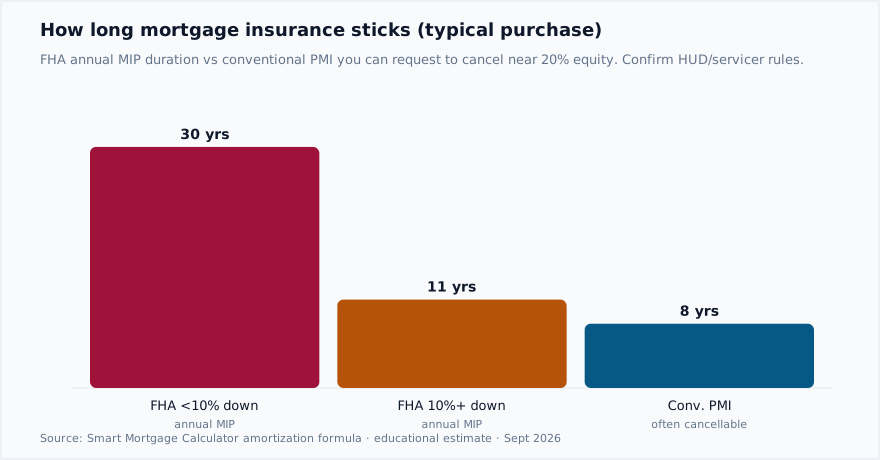
| Insurance duration | Life of loan if under 10% down; often 11 years at 10%+ | Borrower request ~80% original value; auto ~78% if current |
| 2026 1-unit limits (verify) | Floor ~$541,287; high-cost ceiling ~$1,249,125 | Conforming baseline often near ~$832,750; jumbo above that |
| Property review | FHA minimum property requirements (safety/soundness) | Agency/investor overlays; condos can still fail project review |
2026 FHA county loan limits
- National floor (lowest-cost counties): about $541,287 for a 1-unit home in 2026.
- High-cost ceiling for many areas: about $1,249,125 for a 1-unit home.
- Special exception areas (Alaska, Hawaii, Guam, U.S. Virgin Islands) can publish higher limits.
- Multi-unit properties have separate higher schedules — check the county and unit count.
I look up the county before I would let anyone offer on a high list price. A coastal California or New York metro listing may clear high-cost FHA caps while a Midwest county sticks near the floor. Conventional conforming limits (FHFA) are a parallel track — often near about $832,750 baseline in 2026 for many counties. I pick the county in the FHA calculator because I got tired of national blogs that never mention the map.
FHA MIP duration: the 10% / 11-year rule most buyers miss
Most purchase borrowers finance about 1.75% upfront MIP into the loan and pay monthly annual MIP (often near 0.55% of the base loan for common scenarios — confirm current HUD figures). I used to stare at the monthly MIP line like that was the whole story. Duration is the story. Upfront MIP is a separate hit that often gets financed, so the balance is bigger even when monthly MIP later stops.
- With less than 10% down, annual MIP typically lasts for the life of the loan (or until you refinance or sell).
- With 10% or more down, annual MIP can usually be canceled after 11 years if other program conditions are met.
- Upfront MIP is separate and often financed into the loan — it raises the balance even when monthly MIP eventually stops.
Stretching to 10% down hurts cash at closing. In my $350,000 example it is also the difference between annual MIP that typically never falls off and an 11-year clock. That is why I refuse to call “FHA with 3.5% down” and “FHA with 10% down” the same product. Confirm current HUD duration rules — handbooks get updated. Then compare conventional PMI you can request to cancel around 20% equity — PMI removal.
National FHA eligibility basics
- Credit: many lenders work FHA from about 580+ with 3.5% down; scores from about 500–579 often need about 10% down — individual lenders may set higher overlays.
- Down payment: typically 3.5% or 10% as above; gift funds often allowed with documentation.
- DTI: underwriting can flex with compensating factors; still budget near sustainable housing ratios.
- Property: FHA appraisals emphasize minimum property requirements (safety and soundness), not cosmetic perfection.
Conventional loans — PMI can exit
Conventional loans follow Fannie Mae / Freddie Mac guidelines (or jumbo investor overlays). PMI rates depend on LTV and credit. The advantage I care about is exit: PMI is usually cancellable once you reach about 20% equity — unlike many FHA low-down scenarios. That is why I model a 5–7 year hold instead of month-one only.
Why lender overlays decide close calls
Two lenders can cite the same FHA or Fannie guidelines and still disagree on a condo, gift funds, or a credit event. HUD minimums are not every shop’s minimums. I tell people to shop a specialist when a big box declines a file that looks guideline-eligible — overlays vs guidelines. I cannot override an overlay from Franklin. I can tell you to ask which rule they used.
Worked mindset (not a quote)
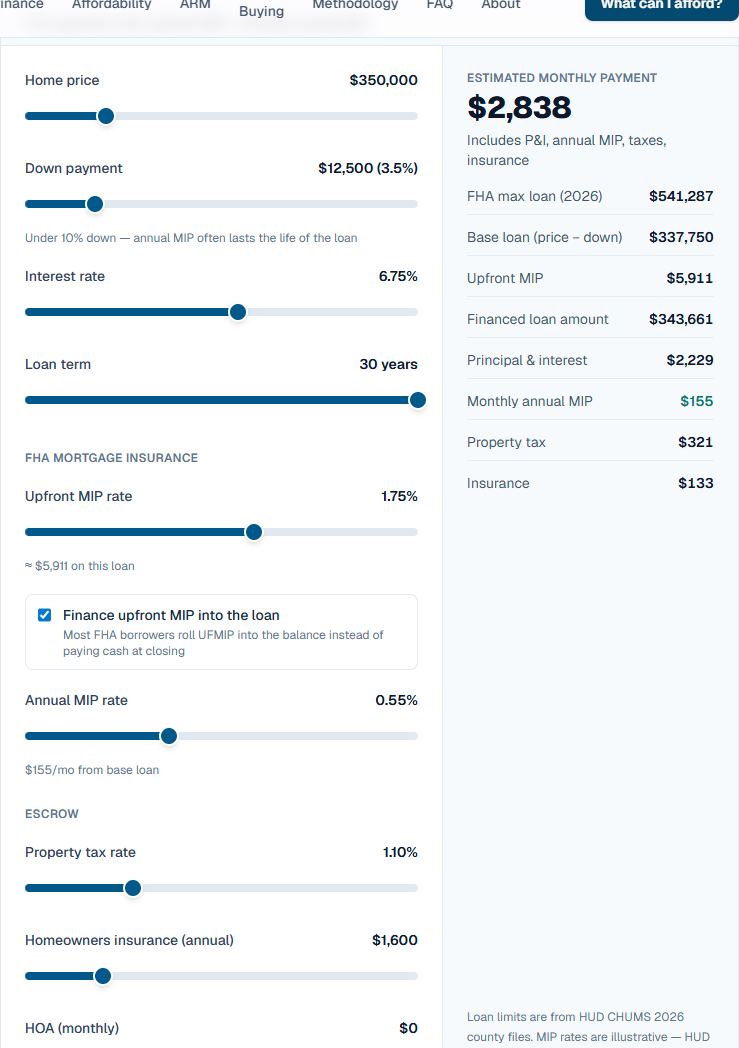
On a $350,000 purchase with 3.5% down, FHA finances most of the price and adds monthly MIP on top of P&I, taxes, and insurance. I ran that screenshot in our own tool: base loan about $337,750 before financed upfront MIP, $2,838 PITI in that September 2026 capture. A conventional 5% down loan may price worse on day one if credit is thin, but PMI can later cancel. If I expected to refinance to conventional once equity and credit improved, I would still use FHA as a bridge — after checking the county limit. Taxes and insurance still decide the payment. I model full PITI in a state-aware mortgage calculator.
Seller concessions by program
FHA commonly allows seller concessions up to about 6% of the lesser of price or value toward allowable closing costs; conventional caps often land between about 3% and 9% based on down payment. I want those as credits on the settlement statement, not informal price cuts that confuse the appraisal. More: down payment, closing costs, and concessions.
How to decide
- Model FHA with financed upfront MIP in the FHA calculator.
- Model conventional at the same price in the mortgage calculator with realistic PMI.
- Compare cash to close, month-1 payment, and whether insurance can fall off — including 3.5% vs 10% down FHA.
- Collect Loan Estimates from lenders who actually close FHA regularly — overlays differ.
- Compare financed vs paid-in-cash upfront MIP on cash-to-close.
- Plan the exit: many borrowers refinance to conventional once equity supports dropping PMI — refinance guide.
I verify limits on HUD’s official lookup and I still tell you to confirm MIP factors with a licensed FHA lender. I design the calculator. I do not underwrite the file.
FAQs
Is FHA always cheaper with 3.5% down?
Month one can look cheaper if conventional PMI and pricing are harsh. Over a 7–10 year hold, life-of-loan FHA MIP at 3.5% down often loses to conventional PMI that you cancel — or to FHA at 10% down with the 11-year clock. Run both in the FHA calculator and the conventional calculator.
Can I drop FHA MIP without refinancing?
Usually not when you put less than 10% down. Extra principal and recasts do not rewrite HUD’s duration rules. The common exit is a conventional rate-and-term refinance once equity and credit support dropping PMI.
Do FHA county limits apply to the price or the loan?
The base loan (and financed upfront MIP, depending on how you structure it) has to fit the county maximum. A high list price with a large down payment can still work; a high list price with 3.5% down often will not in a floor-limit county.
Why did one lender decline an FHA file another would take?
Overlays. HUD sets a floor; shops add score, condo, gift, and reserve rules. Ask whether the denial is a guideline or an overlay, then take the package to a lender that closes FHA weekly — shopping and overlays.
Keep reading
ARM vs. Fixed-Rate Mortgage: Stress-Test the Reset Before You Take the Teaser
I built the ARM calculator because teasers look like a cheat code until you recast the remaining balance at the cap.
VA Loan Entitlement, Residual Income & Funding Fees (2026)
I wired VA residual tables into the calculator from Franklin — South family-of-four is $1,003, and DTI-only thinking still fails files.
This article is for general educational purposes only and is not financial advice. Rates and figures are indicative and may change. Consult a licensed mortgage professional about your situation. See our disclaimer.