How to Get the Best Mortgage Rate: Loan Estimates, Points, Locks & Overlays
By Michael Hubbard, Founder & editor · Published August 6, 2026 · Updated September 11, 2026 · 9 min read
Headline averages — like our indicative 6.75% site default as of June 2026 — are a starting point I typed into the calculator myself, not your price. Your personal rate is credit, LTV, product, points, and how you shop. I come at this as a systems person in Franklin who got tired of incomparable quotes. Getting a single quote feels efficient. In every same-day Loan Estimate set I have lined up for this site, spreads of more than 0.5 percentage points on rate, plus fat fee differences, show up often enough that I stopped treating the first number as real.
Step 1: What I clean up before I burn inquiries
- Pull all three credit reports; dispute errors; lower revolving utilization.
- Know your target purchase price or refinance balance, down payment, and property type.
- Decide whether you want a zero-point quote, a one-point buydown, or lender credits for cash to close.
- If credit needs work, spend weeks or months first — credit guide.
Step 2: Shop 3–5 Loan Estimates the same day
Mortgage shopping inquiries inside a focused window (commonly about 45 days under current FICO mortgage-scoring treatment — confirm your model) typically count as one shopping event. I use that window like it is perishable, because it is. Market moves between Tuesday and Friday can make Friday’s quote look “worse” even if the lender is competitive. That is why I insist on same-day comparison when I am teaching this. I have watched a Thursday rally make a perfectly fine lender look like they raised prices overnight.
- Request written Loan Estimates (not verbal "about 6.5%") from at least three lenders; five helps if you have condo, self-employment, or credit quirks.
- Match loan amount, lock period, occupancy, and points/credits assumption across every LE.
- Include a bank, a credit union or mortgage banker, and at least one broker or specialty lender if overlays might be an issue.
- Compare the note rate, APR, origination charges, and third-party fees that can actually change with shopping.
- Compare interest paid over the years you actually expect to keep the loan — not a 30-year APR if you will sell in year five.
What to compare (not just the headline rate)
- Interest rate and whether it assumes points or lender credits.
- APR and total lender fees on the Loan Estimate.
- Lock length, float-down options, and extension fees.
- Whether “no-cost” just means a higher rate.
A same-day LE worksheet
When I line up quotes I force every column to match except the lender. A sheet like this is what “shopping” actually means:
| Compare this | Lender A | Lender B | What to do |
|---|---|---|---|
| Note rate / points | 6.75% / 0 | 6.50% / 1 pt ($4,000) | Need a 0-point and 1-point quote from each |
| P&I | $2,594 | $2,528 | $66/month is real; points may still lose if you move |
| Origination | $1,495 | $0 (broker fee elsewhere) | Ask A to match; origination is often movable |
| Lock / float-down | 45-day; no float-down | 30-day; float-down 0.5% fee | Price the lock length you actually need |
| APR | Looks higher | Looks lower | APR assumes you keep the loan; use your hold period instead |
Step 3: Negotiate with competing LEs
I email the preferred lender a competing Loan Estimate and ask them to match rate, credits, or the fees they actually control. Many will. I am not being difficult — I am doing the comparison work the market expects. I do not assume the lowest note rate wins: a quote with one point prepaid can look cheaper while costing more cash. That is the whole reason I charted break-even instead of trusting a round “five years.”
Discount points: break-even vs lender credits
Discount points let you pay extra at closing for a lower interest rate. One point costs 1% of the loan and often lowers the rate by about 0.25%, though the exact trade depends on the lender and the market day. Origination points are different — I make the loan officer say which one is on the LE. I got tired of “points” meaning three different fees in three conversations.
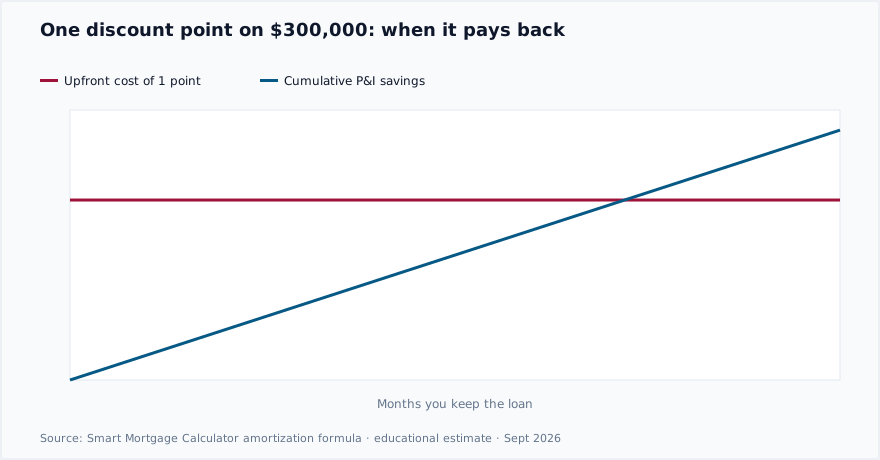
On a $300,000 loan, one point costs $3,000. If it saves $45 a month, break-even is about 67 months. If I refinance or sell in year three, I likely lost money on those points. At an indicative 6.75% 30-year rate, small rate cuts change P&I by dozens of dollars per month — meaningful over a decade, modest over two years. I use the mortgage calculator twice: once at the no-points rate and once at the bought-down rate. Divide the cash paid for points by the monthly difference. That is the only break-even I trust.
Lender credits work the other direction: I accept a higher rate so the lender pays part of closing costs. “No-cost” loans almost always price those credits into the rate. Credits help if I am cash-constrained; points help if I am a long-horizon owner. I ask every lender for a zero-point quote and a one-point quote on the same day. I also ask whether seller concessions can fund points or a temporary buydown within program caps — concessions and cash to close.
- Points often make sense if you will stay well past break-even, have cash without draining reserves, and are unlikely to refinance soon.
- Skip them if you might move within a few years, would rather put cash toward a larger down payment to avoid PMI, or expect a refinance before break-even — refinance guide.
- Purchase points on a primary home are often deductible in the year paid under current IRS rules; refinance points are usually amortized — confirm with a tax professional.
Rate locks vs float-downs
- Lock when you cannot afford rates rising before closing — especially once under contract with a fixed closing date.
- Float only if you have schedule flexibility and a written plan for when you will lock.
- Ask about float-down: market-move threshold, fee (often roughly 0–1% of loan amount), one-time vs multiple, whether it shortens lock life, and how points are treated.
- Confirm lock-extension fees before the lock expires — extensions can erase a “win.”
Overlays vs guidelines: why one lender says no
Borrowers hear “you don't qualify for FHA” or “VA won't do this” when the real story is “this lender's overlay won't.” I am not a loan officer, but I have read enough adverse-action letters in reader questions to stop collapsing guideline and overlay into one word. Agency and Ginnie Mae guidelines set a baseline; each bank, credit union, and investor adds extra rules. Automated underwriting can say Approve/Eligible while a lender still declines on overlay. That is why I tell people to diversify who sees the file.
- FICO floors above FHA's published minimums (for example, some lenders want 620–640+ even when FHA allows lower with more down).
- Condo and manufactured-housing project restrictions beyond the agency list.
- Self-employment or 1099 documentation layers that exceed guideline minimums.
- Limits on funds to close from certain online bank dumps without seasoned paper trails.
- VA lenders requiring residual income well above the VA regional charts.
Depository banks often keep overlays tight because loans sit on the balance sheet or feed conservative investors. Mortgage bankers and brokers may access multiple investor matrices. That does not make every broker better; it means I will not send a quirky condo file to only one retail bank. The flashiest online rate is often the tightest overlay. A slightly higher rate from a specialist who can close beats a teaser quote that dies two weeks before closing. I would rather be slightly “expensive” and funded.
What to do after a decline
- Ask in writing: guideline issue or overlay? Which rule citation?
- Request the adverse action reason codes and keep your Loan Estimate for comparison.
- Take the same package to a lender that advertises the niche (recent credit event, condo, VA residual, foreign national jumbo, etc.).
- Still shop 3–5 LEs in a rate-shopping window so you are not stuck with the first approval's pricing.
Builder or “preferred” lender is another single-quote trap
Builder incentives can be real — and still lose to an independent quote plus a seller concession. I always want both sheets of numbers before anyone waives shopping. Preferred is a marketing word. It is not a fiduciary duty.
Worked comparison
On a $400,000 loan near 6.75%, a 0.25% improvement without points saves on the order of $60+/month. Paying one point ($4,000) for that quarter point only wins if I stay past break-even. I run both paths in the mortgage calculator before I would negotiate. That $66/month gap is the one-quote tax I keep quoting because it is boring and expensive.
FAQs
Should I lock before house hunting?
Pre-approvals help. Long locks before an address can be pricey — ask about lock-and-shop programs and what happens if you do not find a house before the lock dies.
Do online lenders always win?
Not on overlays or complex income. Compare written Loan Estimates either way. The flashiest rate is often the tightest overlay.
Is the broker always cheaper?
Brokers can shop multiple investors; they are not magic. Still compare written LEs, including broker compensation, against a bank and a credit union.
Do float-downs refund points?
Policies vary. Get float-down fees, market-move thresholds, and point treatment in writing before you lock.
Can I roll points into the loan?
Sometimes as financed costs within LTV limits. That raises the balance and changes break-even. In my $300,000 6.75%→6.50% test, the $3,000 point took about 60 months to earn back — financing the point makes that clock longer.
I confirm every number on the Closing Disclosure. This guide is educational — verify pricing, lock policies, overlays, and credit treatment with a licensed loan officer. Related: 2026 rates overview and common pitfalls.
Keep reading
Current Mortgage Rates in 2026: What Homebuyers Should Expect
Where mortgage rates stand in 2026, what drives them, and how shopping Loan Estimates and locks can improve your personal rate.
ARM vs. Fixed-Rate Mortgage: Stress-Test the Reset Before You Take the Teaser
I built the ARM calculator because teasers look like a cheat code until you recast the remaining balance at the cap.
This article is for general educational purposes only and is not financial advice. Rates and figures are indicative and may change. Consult a licensed mortgage professional about your situation. See our disclaimer.