How to Improve Your Credit Score Before Buying a Home
By Michael Hubbard, Founder & editor · Published May 12, 2026 · Updated September 11, 2026 · 9 min read
I pull my own credit the same way I tell readers to: all three bureaus, on a calendar, not the week I need a letter. I am not a credit-repair shop. I will not sell you a tradeline or promise that a 20-point bump maps to a specific quote. What I can show is why score bands matter in mortgage pricing, and why the month after pre-approval is when otherwise careful people blow the file. Lenders typically re-check credit and employment shortly before closing. New loans, maxed cards, and unexplained deposits are how “almost closed” deals die. I have watched that pattern in enough reader questions to write this as a warning, not a vibe.
Why I bother with score bands at all
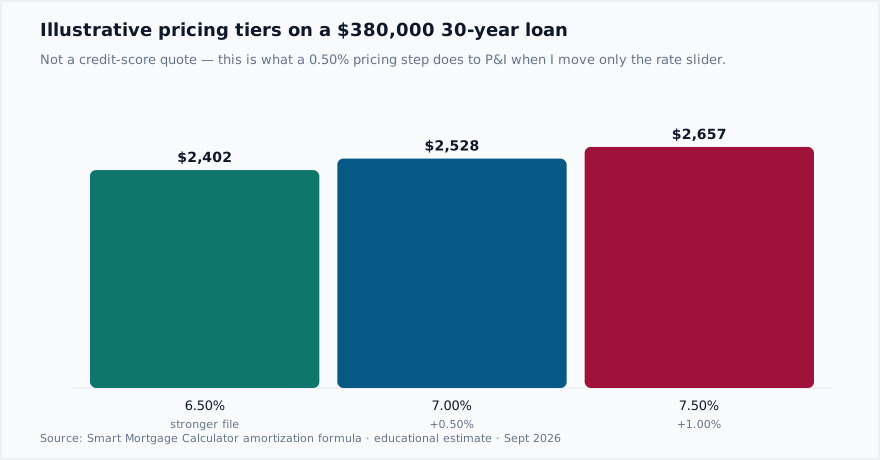
Lenders price risk with loan-level pricing adjustments tied to score bands and LTV. A higher score is a cheaper risk. On a $350,000 loan, even a 0.5% rate difference is tens of thousands over the life of the loan — I check it in the mortgage calculator whenever someone tells me “it’s only a quarter point.” FHA may still work mid-500s files with more down. Conventional pricing, in my experience looking at public LLPA logic, improves sharply as you climb through 680, 720, and 760. I do not pretend I can quote your band. I do pretend the slider is worth staring at.
What I actually do in the months before applying
- Pay every bill on time — payment history is the single biggest factor.
- Lower credit utilization to under 30% (ideally under 10%) of revolving limits; asking for limit increases without new hard pulls can help if you keep balances flat.
- Avoid opening or closing accounts in the months before you apply.
- Dispute errors on your credit reports — they are more common than you think; pull all three bureaus.
- Keep older accounts open to preserve average account age.
- If you are a thin-file borrower, ask lenders which bureau and scoring model they use (often a classic FICO mortgage score, not a free VantageScore app).
Timing your application and the ~45-day shopping window
I give a file three to six months of boring, on-time behavior before I would apply. When I shop a mortgage for this kind of research, I request Loan Estimates inside a focused window — often about 14–45 days depending on the scoring model — so multiple lender inquiries count as one shopping event. That is how I collect 3–5 competing LEs without a stack of unrelated hard pulls. Details: best mortgage rate guide. Opening an auto application outside that window, or stretching mortgage shopping over six months, is how I would accidentally stack inquiries. I have done the “I’ll just check one more lender next quarter” mistake in other consumer shopping. I do not repeat it here.
After pre-approval: mistakes that ruin closings
Anything that changes DTI, score, or the asset story between pre-approval and funding can reprice the loan — or stop it. These feel harmless because they are how adults live. They are not how a mortgage file lives.
- Do not open new credit or finance purchases. Furniture financing, a new auto loan, or another credit card adds monthly obligations and can lower your score via new inquiries and average age of accounts. Even a $40/month store card can matter on a thin approval. Wait until after closing.
- Watch utilization and unpaid collections. High revolving balances hurt scores quickly. Pay down utilization early — ideally months ahead — and dispute or resolve collections that a lender overlay will force to be paid anyway.
- Job changes and large unexplained deposits. Switching employers, switching from W-2 to 1099, or receiving a large gift/cash deposit without a paper trail triggers VOE letters and source-of-funds conditions. Keep the same employment story when possible, and document gifts with proper gift letters and wire paths — never co-mingle cash that cannot be traced.
- VA buyers: even with acceptable DTI, thin residual income for your region and family size can block a VA approval. New debts after pre-approval eat residual income first — VA residual income.
Checklist before and after pre-approval
- Pull your credit early; fix errors and plan paydowns.
- Freeze lifestyle financing until funded.
- Tell your loan officer before any job change.
- Keep gift and earnest-money paths documented.
- Ask what the lender re-checks in the final week.
Overlays: why a "guideline-eligible" file still gets declined
Agency guidelines are not the same as a particular lender’s appetite. One bank may want 680+ for low-down conventional while another will run 640. Credit unions, mortgage bankers, and brokers disagree for boring operational reasons. If I were declined, I would ask whether the reason was guideline or overlay — then I would shop a specialist instead of rewriting my personality. See lender overlays vs loan guidelines.
Worked utilization example (the lever that moves fastest)
Payment history takes months to rebuild after a miss. Utilization can move as soon as the issuer reports the new balance — often one billing cycle. I use a simple worksheet before anyone applies:
| Revolving balances | Utilization | What I would do before applying |
|---|---|---|
| $8,000 | 40% | Too high for a mortgage shop window — pay this down first. |
| $6,000 | 30% | Common “okay” cutoff; still leave room if a lender re-pulls. |
| $2,000 | 10% | The band I aim for on a file I care about. |
| $0 on every card | 0% | Not always ideal — some scoring lore prefers a small reported balance on one card. Do not open new cards to game this. |
On a $20,000 limit, moving from $8,000 down to $2,000 is a $6,000 cash decision. Compare that cash to a half-point of rate on a $380,000 loan: in the chart above, 6.50% vs 7.00% is $126/month of P&I. Six months of that gap is already $756 — and the loan lasts longer than six months. I would rather park the $6,000 on revolving debt for a cycle than “save it for closing” while shopping at a worse pricing tier.
Worked pricing intuition
I keep a two-borrower thought experiment on the same $400,000 house with 5% down. Borrower A scores 760; Borrower B scores 680. A may see both a lower note rate and cheaper PMI. Over five years that gap can dwarf the cost of waiting a few months to raise the score. I run the payment both ways, then I decide whether waiting is cheaper than buying now. I do not decide it with a motivational quote.
FAQs
Should I pay collections before applying?
Often yes for mortgage underwriting, even if the FICO effect is partial. Ask your loan officer which debts must be cleared for their overlay — some shops require paid collections that a guideline file would allow.
Do authorized-user accounts help?
Sometimes for FICO; mortgage underwriters may still scrutinize whether you actually pay the account. Do not add AU tradelines in the shopping window as a gimmick — it can look like credit repair and still not move the mortgage score the lender uses.
Does checking your own credit hurt?
Soft pulls usually do not. Lender hard pulls do. Cluster mortgage shopping inside one focused window (often about 14–45 days depending on the model) so those inquiries count as a single event.
Is a free VantageScore the number my lender uses?
Usually not. Mortgage pricing typically uses a classic FICO mortgage score from one or more bureaus. Treat app scores as a trend, then ask the loan officer which model and bureau they pull.
I pair credit work with a budget in the affordability calculator so a prettier score does not buy a house the escrow will punish. Related: mortgage pitfalls overview. Educational guidance only — not credit repair, not a loan offer. Confirm underwriting with a licensed lender.
Keep reading
How Mortgage Amortization Works: Why Year 1 Is Almost All Interest
I keep the first-month split on the wall: $1,688 interest and $258 principal on a $300,000 loan. That is amortization, not a trick.
Extra Principal Payments vs. Biweekly Mortgages: What Actually Shortens the Loan
I ran +$100 and +$200 extra principal on the same $300,000 note. The calendar moved. The rate did not. That is the whole trick.
This article is for general educational purposes only and is not financial advice. Rates and figures are indicative and may change. Consult a licensed mortgage professional about your situation. See our disclaimer.