Extra Principal Payments vs. Biweekly Mortgages: What Actually Shortens the Loan
By Michael Hubbard, Founder & editor · Published September 11, 2026 · 9 min read
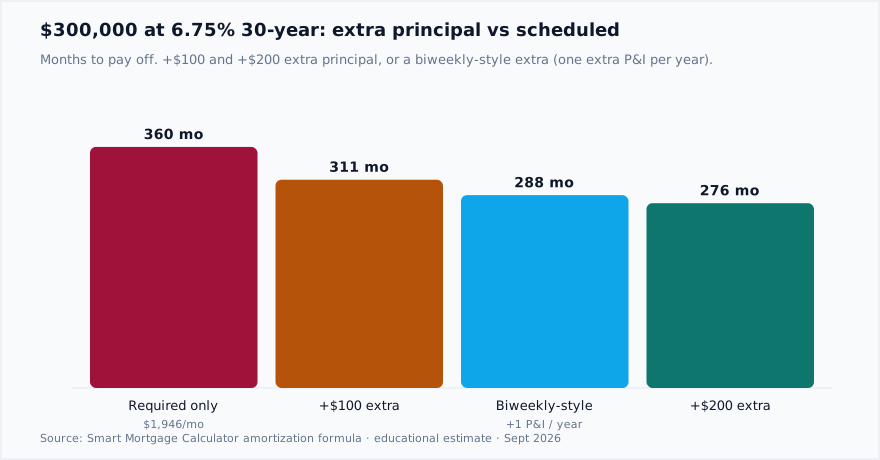
I get asked whether a “biweekly mortgage” is a product you have to refinance into. Usually it is just a payment habit: send half the P&I every two weeks, which lands 26 half-payments a year — one extra full P&I compared with 12 monthly payments. I modeled that habit as extra principal of one P&I divided by 12, added to the required monthly payment, on a $300,000 30-year at 6.75%. Required payoff is 360 months and about $400,000 of interest. The biweekly-style extra paid off in 288 months with about $306,000 of interest. No new loan. No new rate. I am not a servicer. I am the person who had to make extra principal do something visible in the math.
This is the sibling of the hybrid in my 15- versus 30-year piece, where I sent the full 15-year payment at the 30-year rate. Here I keep the required 30-year payment and add a smaller, sustainable extra. I care about sustainable. A $200 extra you skip every winter is a budget. A $200 extra you treat as required is how people bounce checks.
The four calendars I ran on $300,000
| Habit | Months to pay off | Lifetime interest |
|---|---|---|
| Required P&I only ($1,946) | 360 | About $400,000 |
| +$100 extra principal | 311 | About $335,000 |
| Biweekly-style (one extra P&I per year) | 288 | About $306,000 |
| +$200 extra principal | 276 | About $291,000 |
How I would label the extra so it actually hits principal
Servicers are not mind readers. If I send $2,146 on a $1,946 bill without instructions, some shops park the extra in a suspense account or treat it as next month’s payment early. That does not shorten the loan the way I modeled. I would use the servicer’s extra-principal screen, a separate principal-only payment, or a memo the investor actually honors. I would get the next statement and confirm the balance dropped by more than the scheduled principal. If it did not, I would call before I sent the next one.
- Confirm the note allows prepayment without penalty (most modern owner-occupied loans do; read yours).
- Use the servicer’s principal-only option, not a vague overpayment.
- Match the extra to a monthly habit or a known bonus month — not to leftover checking-account guilt.
- Check the next statement’s unpaid principal balance.
- Do not recast if the goal is faster payoff. Recast lowers the required payment and can erase the extra’s speed — recast vs refinance.
I checked the statement logic the way a picky bookkeeper would. Scheduled principal in month 1 on that $300,000 loan is about $258. If I send $100 extra and it truly hit principal, unpaid principal should drop by about $358, not $258. If the statement only dropped $258, the extra sat in suspense or prepaid next month. That is the only audit I trust. Apps that round up coffee purchases are fine if they pass this test. I do not care about their branding.
Biweekly programs versus doing it yourself
Some companies sell a biweekly draft for a setup fee. I am allergic to fees that duplicate a free calendar. If your payroll is biweekly, sending half the P&I each paycheck can match cash flow. You can also add 1/12 of P&I to each monthly payment and get the same extra-principal math without a third-party draft. I modeled the second version because that is what our monthly engine can see. If a vendor charges $300 to “set up biweekly,” I would rather put the $300 on principal this month.
The PMI and ARM versions of the same habit
On a $400,000 house with 5% down, I already showed that +$200 extra principal pulled conventional PMI to the 80% original-value line in 89 months instead of 127 — PMI cancellation test. On an ARM, extra principal shrinks the balance that will recast at reset — ARM vs fixed. Same lever. Different reason to pull it. I would not do both a cash-draining extra and a starved emergency fund. Principal is not a savings account you can get back without a cash-out refinance or a HELOC.
When I would not pay extra
- High-interest revolving debt is still open. I would crush 22% cards before I extra-principal a 6.75% mortgage. The amortization chart is not a morality play.
- Cash reserves are thin. Insurance and tax escrow can jump. I keep a cushion in Georgia for that reason even when taxes are milder than Texas.
- I expect to sell in two years. Extra principal is mostly a gift to the next owner’s equity math unless the sale is certain to recoup it.
- The extra would be more valuable as a larger down payment on the next house, or as points with a hold period I have actually charted — points break-even.
How I would decide the dollar amount
I start with the payment I could miss for three months and still sleep. Then I pick an extra below that line. $100 survived my $300,000 test with a meaningful calendar change — 49 months and about $65,000 of interest. $200 was better: 84 months and about $110,000. The 15-year payment as a hybrid extra ($626 more in that other article) is a different personality: faster, less skippable in practice even though the note allows a skip. Pick the personality you will still have in February. If $100 is what survives, I would rather have $100 for ten years than $400 for three months. A lump-sum extra in month 1 is the same lever as a habit, just once. A $2,400 bonus in month 1 is not twelve times as powerful as $200 a month for a year, because the monthly extras also skip later interest — but the lump beats waiting a year to start. I would use a bonus as a lump and a paycheck as a habit, not the other way around.
Run your balance in the mortgage calculator and add the extra in your own spreadsheet the way I did, or just raise the payment and watch total interest. Confirm with your servicer that extras apply to principal. Educational math, not a loan modification.
FAQs
Does extra principal change my tax deduction?
It reduces future interest, so deductible interest can fall in later years if you itemize. That is a tax-person question. The payoff math does not care.
Will my servicer automatically shorten the term?
On a standard amortizing note, extra principal shortens the calendar automatically because the required payment stays the same while the balance falls faster. You should still see it on the statement. You do not usually get a new 28-year note in the mail.
Is a round-up app worth it?
If it actually sends principal-only extras and the fee is tiny, it is just a small version of the $100 test. If it is a branded biweekly product with a fat setup charge, I would skip it and send the extra myself.
Should I recast after a bonus instead of paying extra monthly?
Recast if you want a lower required payment and you already like the rate. Keep paying the old payment as optional extra if you want speed. Do not recast and then also expect the old payoff date. You chose cash flow.
Keep reading
How Mortgage Amortization Works: Why Year 1 Is Almost All Interest
I keep the first-month split on the wall: $1,688 interest and $258 principal on a $300,000 loan. That is amortization, not a trick.
How Much Down Payment Do You Need? Closing Costs, Concessions & First-Time Paths
I do not treat 20% as a personality test. I treat it as the PMI cliff, then I stack closing costs and Georgia first-time paths on top.
This article is for general educational purposes only and is not financial advice. Rates and figures are indicative and may change. Consult a licensed mortgage professional about your situation. See our disclaimer.