Mortgage Pitfalls Homebuyers Should Avoid (2026): The Mistakes That Quietly Cost Thousands
By Michael Hubbard, Founder & editor · Published August 6, 2026 · Updated September 11, 2026 · 8 min read
I did not write this list from a closing table. I wrote it from the questions that land in the contact form and from the ways our own calculators punish optimistic inputs. The expensive mistakes cluster: credit changes after pre-approval, one-lender shopping, MIP duration nobody modeled, overlays treated as “the program said no,” and PITIA that was really just P&I. Avoiding them can mean a better rate or not wiring a surprise check. The deep dives live in the related guides. This is the field manual I wish I could staple to a pre-approval letter.
I pair this with our questions nobody thinks to ask page when I would interview an agent or walk a house. I use the best-rate shopping guide when the job is comparing Loan Estimates, not collecting vibes.
Financial and credit pitfalls
- New credit after pre-approval. Car loans, furniture financing, or new cards raise DTI or ding scores. Lenders re-pull credit and verify employment near closing — an “approved” file can still change. Full checklist: credit before (and after) you apply.
- DTI-only thinking (especially VA). Residual income by region and family size often outweighs a “fine” DTI. Marginal residual income can mean denial. See our VA residual income guide.
- Under-estimating PITIA. Principal and interest are only part of the housing payment. Taxes, insurance, HOA, and maintenance rise — sometimes sharply — after purchase. Location-aware budgeting: how much house can I afford.
- Late credit cleanup. Collections, high utilization, and report errors are far easier to fix months ahead than days before underwriting.
- Hard inquiry clustering outside a shopping window. Multiple mortgage applications within about 45 days usually count as one inquiry; spreading them over months can hurt the score.
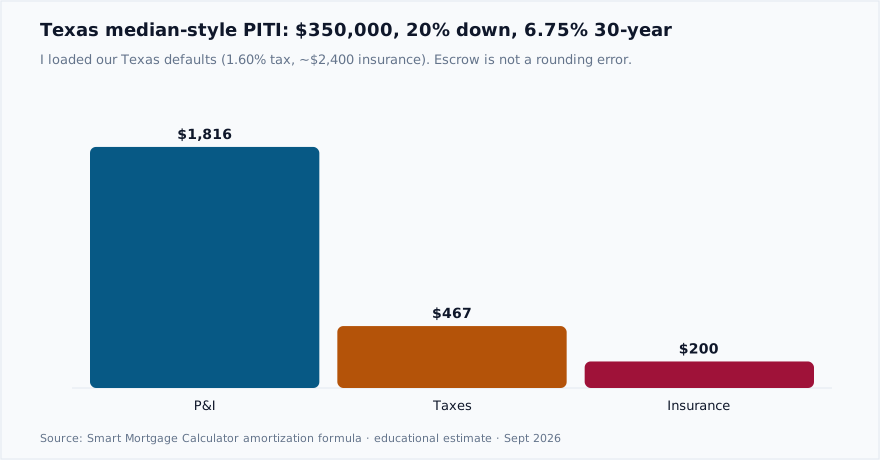
What “looks cheap” vs what you actually pay
I keep a side-by-side like this when a file feels fine in conversation and expensive in the calculator:
| What you were shown | What got skipped | What it cost in a test |
|---|---|---|
| P&I on a $350,000 Texas home | Taxes + insurance escrow | $1,816 P&I vs $2,483 PITI — escrow was 27% of the payment |
| One lender’s 6.75% on $400,000 | A same-day LE at 6.50% | About $66/month, or ~$3,960 over five years, before compounding |
| FHA 3.5% down “cheap cash” | Life-of-loan annual MIP | Years of MIP vs an 11-year clock at 10% down or cancellable conventional PMI |
| Pre-approval letter | New auto loan before closing | DTI and residual both move; VA files fail residual first |
Lender shopping and comparison pitfalls
- One quote only. Spreads between lenders for the same profile often exceed 0.5 percentage points. Same-day Loan Estimates from 3–5 lenders are high-ROI homework.
- Rate-only comparison. Compare APR, points, lender fees, and interest over your expected hold period. “No-cost” loans usually recover fees in a higher rate — see points break-even and shopping.
- Assuming every lender follows the same rules. FHA and VA set national minimums; many shops add overlays. Meeting the program does not guarantee approval everywhere — overlays are covered in the same shopping guide.
- Never negotiating. Present a competing Loan Estimate. Originators often match fees or price when the alternative is losing the file.
- Builder or “preferred” lender as the only quote. Incentives can be real and still lose to an independent LE plus a seller concession.
Loan structure and cost pitfalls
- Ignoring MI duration. FHA MIP with under 10% down typically lasts for the life of the loan (or until refinance); with 10%+ down it can cancel after about 11 years. Conventional PMI is usually removable at 20% equity — but you often must request it. Details: FHA vs conventional and PMI removal.
- Mishandling seller concessions and buydowns. Caps differ by loan type (often 3–9% conventional by LTV, 6% FHA/USDA, ~4% VA). A temporary 2-1 buydown can beat a similar price cut for cash flow — concessions and cash to close.
- Vague rate locks. Standard locks block rate increases, not decreases. Ask about float-down triggers, fees (sometimes 0–1% of loan), and extension costs if closing slips.
- Wrong product for the horizon. ARMs can look cheap early and shock later; cash-out and streamlined refinance rules have seasoning and benefit tests that differ by program and state.
Process, timing, and documentation pitfalls
- Treating pre-approval as a commitment. Full underwriting still weighs appraisal, title, employment, and assets.
- Appraisal and title surprises. Low values, FHA/VA minimum property repairs, or title defects delay or kill deals. Independent inspections still matter.
- Not shopping insurance and title. Affiliate recommendations are convenient, not mandatory. Quotes vary and change cash to close.
- Skipping local rules. Transfer taxes, recording fees, refinance net-benefit laws, first-time programs, and county FHA limits are location-specific.
- Late VA entitlement checks. Partial entitlement, subsequent-use funding fees, restoration limits, and disability fee exemptions change cash and loan size — verify on the COE early.
Behavioral and long-term pitfalls
- Paying points without a hold-period plan. Break-even only works if you keep the loan long enough.
- Assuming the first or builder’s package is best. Local assistance, Mortgage Credit Certificates, or seller-paid buydowns can beat a retail quote — but only if you ask.
- Job changes, undocumented large deposits, or co-mingled gifts near closing. These trigger underwriting letters and delays.
- Going solo on complex income. Self-employment, multiple W-2s, or multi-unit purchases repay an originator who knows overlays and special programs.
A 10-step check before you lock
- Pull all three credit reports; freeze new installment debt until funded.
- Build a PITIA budget with county tax and a fresh insurance quote — not last year’s listing premium.
- Collect 3–5 same-day Loan Estimates with matched points and lock period.
- Email the preferred lender a competing LE and ask them to match.
- Ask whether a decline would be guideline or overlay — in writing.
- If FHA, compare 3.5% vs 10% down for MIP duration, not just month-one payment.
- If VA, run residual for your region and family size and confirm funding-fee exemption status on the COE.
- Get lock, float-down, and extension fees in writing before you stop shopping.
- Put seller concessions in the contract as a dollar amount toward allowable costs, within program caps.
- Treat the week before closing as a quiet period: no job changes, no furniture financing, documented gift paths only.
Bottom line
The most expensive mistakes are usually preventable: clean credit early, compare full Loan Estimates the same day, ask explicit questions about overlays, float-downs, MIP duration, and concessions, and treat the process as negotiation. I verify current guidelines with lenders (details change), and I size the house on total ownership cost — not P&I alone — using our affordability calculator with the actual state and county. I live in a modest-tax Georgia county. That is exactly why I keep the Texas stack in this article. Comfort is local. The mistake is assuming it travels.
Next: protect credit through closing, why one quote costs you, and questions nobody thinks to ask.
FAQs
Is a pre-approval a commitment to fund?
No. Full underwriting still weighs appraisal, title, employment, and assets. Lenders typically re-pull credit near closing. Treat the letter as a shopping tool, not a close.
How much can one skipped quote cost?
On a $400,000 30-year, 6.75% vs 6.50% was about $66/month in our formula — roughly $3,960 over five years if you never refinance. Same-day Loan Estimates are how you find that gap.
Should I use the builder’s preferred lender?
Get their incentive in writing, then still collect independent LEs. Credits can be real and still lose to a better rate plus a seller concession. Run both sheets before you waive shopping.
What’s the fastest way to blow a VA approval after pre-approval?
New monthly debt. Residual income is leftover cash after PITI and debts. A furniture account that looks tiny on DTI can put a South family-of-four file under the $1,003 chart — VA residual guide.
Keep reading
ARM vs. Fixed-Rate Mortgage: Stress-Test the Reset Before You Take the Teaser
I built the ARM calculator because teasers look like a cheat code until you recast the remaining balance at the cap.
How Mortgage Amortization Works: Why Year 1 Is Almost All Interest
I keep the first-month split on the wall: $1,688 interest and $258 principal on a $300,000 loan. That is amortization, not a trick.
This article is for general educational purposes only and is not financial advice. Rates and figures are indicative and may change. Consult a licensed mortgage professional about your situation. See our disclaimer.