15-Year vs. 30-Year Mortgage: Which Is Right for You?
By Michael Hubbard, Founder & editor · Published March 10, 2026 · Updated September 11, 2026 · 9 min read
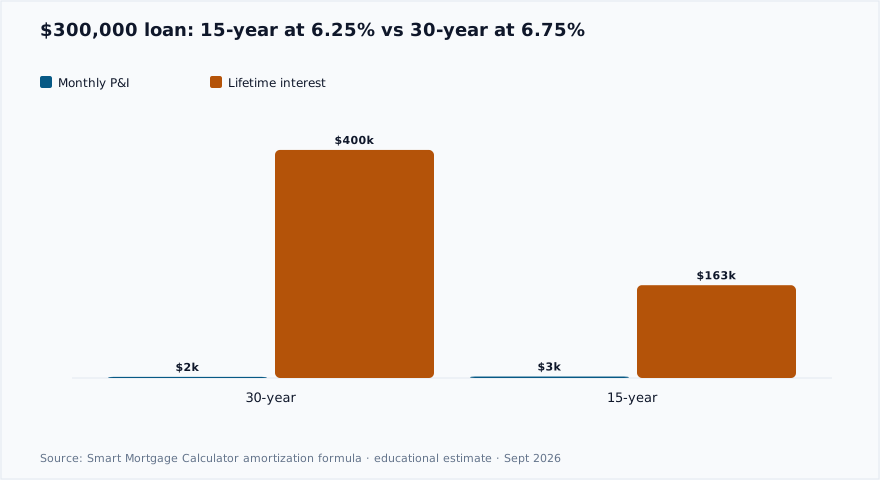
I did not pick a favorite term in a seminar. I picked one in the code. The first version of our calculator used the same interest rate on 15-year and 30-year loans because that is how lazy spreadsheets work. The 15-year payment looked brutal and the interest savings looked magical, and both numbers were slightly wrong. Real 15-year quotes usually price a little cheaper on the same day. When I put 6.25% on the 15-year and 6.75% on the 30-year for a $300,000 balance, the picture got honest: $2,572 versus $1,946 a month, and roughly $163,000 versus $400,000 of lifetime interest. I am Michael Hubbard. I build these tools from Heard County, Georgia. I am not locking your loan. I am telling you what I actually ran, and the rule I use when someone asks me which term to take.
The question I hear is rarely “which term is mathematically cheapest to maturity.” It is “which payment still works if a truck dies in the same month the insurance reprices.” That is a different problem. A 15-year note solves the first. A 30-year note with optional extras solves the second. Mixing them up is how people either overpay for interest or sign a payment they cannot miss.
Why I still respect the 30-year
- Lower required monthly payments — more qualifying power and cash-flow cushion.
- Flexibility to pay extra principal when you choose without being locked into a higher minimum.
- Useful when income is variable or large expenses compete for cash.
- Easier to keep reserves for insurance spikes or repairs — especially in high-insurance states.
When I would lock the 15-year
- Usually a lower note rate than a comparable 30-year loan on the same day.
- Dramatically less total interest and faster equity build.
- Forces a savings habit if you can afford the payment through a rough month.
- Pairs well with strong dual income and modest other debts.
The $300,000 run that settled the argument
I keep a sticky note on the term toggle: same balance, same day, different product. On $300,000 near today’s market, the 30-year at 6.75% lands near $1,946 of principal and interest. The 15-year at 6.25% lands near $2,572. That $626 gap is the whole personality of the choice. I do not treat those figures as a quote — lenders will shade them — but I will not argue term strategy without running the same two sliders. Open the mortgage calculator on your balance and steal my method, not my numbers.
| Path | Required P&I | If paid as planned | Lifetime interest |
|---|---|---|---|
| 30-year at 6.75% | $1,946 | 360 months | About $400,000 |
| 15-year at 6.25% | $2,572 | 180 months | About $163,000 |
| Hybrid: 30-year note, send the 15-year payment | $1,946 required; $2,572 sent | Paid off in 191 months | About $189,000 |
The hybrid I actually ran
A lot of advice says “take the 30-year and just pay extra.” I wanted the number, not the slogan. I took the 15-year payment ($2,572) and applied it every month to the 30-year note at 6.75%. The loan is gone in 191 months — about 15.9 years — with roughly $189,000 of interest. That is $211,000 less interest than making only the required 30-year payment. It is also about $26,000 more interest than locking the true 15-year at 6.25%, because you never received the shorter-term rate. Smaller extras ($100–$200, or a biweekly-style extra) are in extra principal vs biweekly.
The option you keep is the whole point. On a rough month you can drop back to $1,946 without asking the servicer for a modification. A 15-year note does not allow that. You are paying for that option: a slightly longer payoff and the higher 30-year rate. If your income is stable enough that you would never skip the extra, the locked 15-year is cheaper. If you want a safety valve, the hybrid is the honest middle — not a free 15-year.
| Path after 84 payments | Balance still owed | Interest already paid |
|---|---|---|
| Required 30-year only | About $272,000 | About $136,000 |
| True 15-year | About $194,000 | About $110,000 |
| Hybrid (sent $2,572 on the 30-year) | About $205,000 | About $121,000 |
I ran the sale-in-year-seven case because that is how a lot of Georgia moves actually work — a job change, a bigger house, a downsize after the kids leave. If I stop at month 84, the required 30-year still owes about $272,000. The true 15-year owes about $194,000. The hybrid owes about $205,000. The hybrid captured most of the equity speed without locking $2,572 as a required payment. I would still take the true 15-year if I knew I would never miss a month. I would not take it on hope.
The underwriting rule I wish someone had tattooed on me
Lenders size the file on the required payment, not on the extra principal I intend to send. I learned that the annoying way: I kept wanting the calculator to have an “I promise to pay extra” switch that would change qualification. It cannot. A 15-year that looks fine in a perfect month can fail automated underwriting when the same price on a 30-year would clear. If you are stretching, I tell you to take the 30-year that gets you to closing and behave like a 15-year borrower on the months you can. If the 15-year still leaves room under 28/36 after taxes and insurance, I tell you to lock it and stop negotiating with yourself.
How I shop the term, not just the rate
I ask for Loan Estimates on both terms the same day, same points assumption. Some lenders price 15-year products like they want the business. Others barely improve the rate and then hide a point in the fine print. A marketed 15-year that requires a point can lose to a zero-point 30-year plus extras if I might sell before the point earns back. I do not pick a term off a banner ad.
- Compare note rate and APR on each term.
- Check whether you need points to reach a marketed 15-year rate.
- Model total interest if you keep each loan to maturity vs. sell in year seven.
- Ask whether a 20- or 25-year option splits the difference.
- See how to get the best mortgage rate for LE negotiation and points break-even.
Why I built an ARM calculator instead of calling a teaser a 15-year
A 5/1 or 7/1 ARM can start lower than a 30-year fixed and still have a lower required payment than a 15-year. The first time I modeled that, it looked like I had invented a cheat code. Then I stressed the fully indexed payment in the ARM calculator and the cheat code vanished. The full recast is in ARM vs fixed. If the only way a house fits is an ARM teaser, I treat that as a price problem or a cash-to-close problem — not a term branding problem.
The part of PITI the term switch never touches
Switching 15 versus 30 only moves principal and interest. Property taxes, insurance, PMI, and HOA stay. I learned that while wiring state defaults: a “cheap” 15-year P&I in a high-escrow county can still be a worse household payment than a 30-year in Heard County. I always rerun the comparison inside a full PITI estimate on the state-aware mortgage calculator — try Texas or California if you want to see escrow pick a fight with your term choice — and I read how much house I can actually carry before I pretend a term works forever.
When I would refinance or recast later
The pattern I see most: start 30-year for payment comfort, later refinance to 15- or 20-year once income rises — but only if break-even math works. I run that in the refinance calculator before I get romantic about it. A recast is the quieter cousin: lump-sum principal, same rate, remaining term, lower payment. Recast versus refinance: should you refinance in 2026.
How to decide in practice
- Write down the payment you could still make after a temporary income shock — not the payment that works in a perfect month.
- Get Loan Estimates on 15-, 20-, and 30-year terms the same day, same points assumption.
- If the 15-year only fits on paper, take the 30-year and calendar a hybrid extra (the 15-year P&I minus the 30-year P&I) you can skip.
- If dual income is stable and the 15-year still leaves room under 28/36 after taxes and insurance, lock the shorter term and take the better rate.
- Re-run the comparison inside a full PITI estimate — term choice does not change escrow.
I publish the formula on how we calculate. A licensed lender still has to price the file. My job is to keep you from picking a term because a blog told you 15-year people are more serious.
FAQs
Is paying extra on a 30-year the same as a 15-year?
No. In my $300,000 test the hybrid paid off in 191 months at about $189,000 of interest. The true 15-year finished in 180 months at about $163,000 because it also received a lower note rate. Extra principal copies the payoff speed, not the rate.
Should I take a 20-year instead?
Ask for it on the same-day Loan Estimates. A 20-year often splits the payment jump and still cuts a large share of lifetime interest. It is a required payment, though — there is no skip-a-month option the way extras on a 30-year work.
Does extra principal change my tax deduction?
Extra principal reduces the balance faster, so you pay less interest in later years. That can shrink mortgage-interest deductions over time. Tax treatment depends on your filing situation — confirm with a tax professional.
What if I might refinance in a few years?
Then the 7-year snapshot matters more than lifetime interest. A 15-year still builds equity faster; a 30-year keeps cash flow if you are unsure. Do not buy discount points on a term you expect to replace before break-even — see the refinance guide.
Keep reading
ARM vs. Fixed-Rate Mortgage: Stress-Test the Reset Before You Take the Teaser
I built the ARM calculator because teasers look like a cheat code until you recast the remaining balance at the cap.
VA Loan Entitlement, Residual Income & Funding Fees (2026)
I wired VA residual tables into the calculator from Franklin — South family-of-four is $1,003, and DTI-only thinking still fails files.
This article is for general educational purposes only and is not financial advice. Rates and figures are indicative and may change. Consult a licensed mortgage professional about your situation. See our disclaimer.