What Is PMI and How Do You Get Rid of It?
By Michael Hubbard, Founder & editor · Published April 2, 2026 · Updated September 11, 2026 · 9 min read
The PMI line is the feature I argue with myself about most. Conventional loans typically add it under 20% down and drop it at 20%. That is a cliff, and I watched it happen: I dragged the down-payment slider on a $400,000 house from 19% to 20% and the insurance vanished. At 5% down in that same run, modeled PMI at 0.60% of the loan was $190 a month. People treat the cliff as a character test. I treat it as a cancellation calendar plus a cash-reserve problem. I am not your servicer. I am the person who had to code the rule, then explain why the payment did not fall off by magic at month 60.
What I see when I only move the down-payment slider
In the runs I keep, PMI usually prices between roughly 0.3% and 1.5% of the loan per year, billed monthly. On a $280,000 loan that can mean about $70 to $350 a month. Credit and loan-to-value drive the quote more than any slogan about “just putting 20% down.” Lenders also sell single-premium and lender-paid PMI that bury the cost in cash at closing or in the note rate. I dislike lender-paid PMI for long holds because the rate bump does not fall off when equity does.
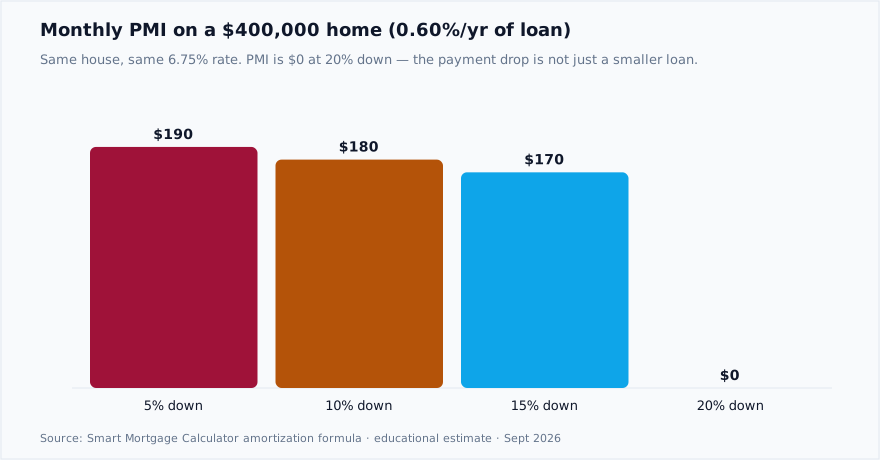
| Down payment | Loan | P&I | Modeled PMI | P&I + PMI |
|---|---|---|---|---|
| 5% ($20,000) | $380,000 | $2,465 | $190 | $2,655 |
| 10% ($40,000) | $360,000 | $2,335 | $180 | $2,515 |
| 15% ($60,000) | $340,000 | $2,205 | $170 | $2,375 |
| 20% ($80,000) | $320,000 | $2,076 | $0 | $2,076 |
How I would actually get conventional PMI off the loan
- Reach about 20% equity based on original value (or current value under servicer rules) and request cancellation in writing.
- Automatic termination: under federal rules for many conventional loans, PMI must terminate once the scheduled balance reaches 78% of the original value, if you are current.
- Appraisal-based removal earlier if home values rise — the servicer's appraisal and seasoning rules apply; you usually pay for the appraisal.
- Extra principal payments to hit the equity target faster — then request cancellation; do not assume the servicer notices automatically before the 78% date.
- Refinance into a new loan once equity supports dropping mortgage insurance, if rate/fee math works.
I would put the cancellation request in writing and keep proof of delivery. Servicers sometimes want recent payment history and will deny the request if the loan is delinquent or if their LTV waterfall fails. If I were close to the line, I would ask what they need before I paid for an appraisal. I would not assume a nice equity number in my head is the number they use.
Test: extra $200/month vs waiting for scheduled 80%
On that $400,000 home with 5% down, the loan is $380,000. Conventional PMI often becomes cancellable when the scheduled balance hits 80% of the original purchase price — $320,000 here — though you still have to ask. I amortized the 6.75% 30-year two ways:
| Payment habit | Months to ~80% original value | PMI paid along the way |
|---|---|---|
| Required P&I only ($2,465) | 127 months (~10.6 years) | About $24,130 |
| Required P&I plus $200 extra principal | 89 months (~7.4 years) | About $16,910 |
The extra $200 cut about 38 months of PMI and roughly $7,220 of premiums — before counting the interest you also avoided on the faster principal drop. The broader extra-principal calendars live in extra principal vs biweekly. Two caveats I keep next to that result: (1) 80% of original value is not the same as 80% of a new appraisal if prices rose; (2) automatic termination at 78% of original value arrives later than a borrower-requested 80% cancellation. If values jumped, an appraisal-based request can beat both calendars. If values fell, extras are how you still get there.
FHA MIP is different — including the 10% / 11-year rule
FHA uses MIP, not PMI, and this is where I burned an evening in the HUD handbook while building the FHA calculator. Most purchase borrowers pay upfront MIP (often financed) plus annual MIP. The duration rule is the part I wish I had learned first: under 10% down, annual MIP typically lasts for the life of the loan unless you refinance out. At 10% or more down, it can usually cancel after 11 years if other conditions are met. Extra principal does not rewrite that clock. I send people to FHA vs conventional when they want the county-limit version of the same surprise. Confirm current HUD language before you rely on any duration rule I typed in 2026.
Mortgage recasting as a partial alternative
If I received a lump sum — bonus, inheritance, sale of another asset — I would ask the servicer in writing whether they recast. Recasting applies a large principal payment and re-amortizes the rest at the same rate over the remaining term. It does not, by itself, cancel PMI. I still have to meet their LTV cancellation rules. It can still be the cheaper way to drop the payment after I have already paid down principal. Recast versus refinance: 2026 refinance guide.
Is avoiding PMI always the right move?
I used to treat 20% down as the grown-up answer. Then I modeled rent versus a few years of PMI while prices moved. Waiting can cost more than the premiums, especially if the house you wanted is gone. I now run three scenarios before I lecture anyone: buy sooner with PMI, wait for 20%, or buy a less expensive home. I also compare FHA MIP duration to conventional cancellation. The “right” move is the one that leaves reserves. Cash-to-close tradeoffs: how much down payment you need.
Shopping notes
- Compare Loan Estimates with the same LTV so PMI quotes are apples-to-apples.
- Lender overlays can require higher scores for low-down conventional even when Fannie/Freddie guidelines allow the file — see overlays vs guidelines.
- Seller concessions cannot usually eliminate PMI directly but can fund closing costs so more of your cash goes to down payment.
I built the main mortgage calculator to add PMI under 20% down and remove it at 20% or above so the cliff is visible. The exact rule in our math is on how we calculate. Confirm cancellation with your servicer. This is educational, not a promise that your investor uses my waterfall.
FAQs
Does the servicer cancel PMI automatically at 80%?
Usually no. Borrower-requested cancellation around 80% of original value typically needs a written request and a current payment history. Automatic termination for many conventional loans is later — often when the scheduled balance hits 78% of original value, if you are current. Put the 80% request in writing anyway.
If my home’s value rose, can I cancel sooner?
Often yes, via an appraisal-based request, subject to seasoning and the servicer’s LTV waterfall. You usually pay for that appraisal. If the new value does not support 80% (or the servicer’s threshold), you lost the appraisal fee and still have PMI.
Is lender-paid PMI a free way out?
No. Lender-paid PMI usually means a higher note rate for the life of the loan. Borrower-paid monthly PMI can fall off; a rate bump generally does not. Compare a zero-point quote with borrower-paid PMI against the lender-paid structure on the same Loan Estimate day.
Will extra principal cancel FHA MIP?
Not the way conventional PMI works. FHA annual MIP duration follows HUD rules (life of loan under 10% down; often 11 years at 10%+ down). A recast or extra principal does not rewrite that clock. Exiting usually means a conventional refinance once equity and credit support it.
Keep reading
How Mortgage Amortization Works: Why Year 1 Is Almost All Interest
I keep the first-month split on the wall: $1,688 interest and $258 principal on a $300,000 loan. That is amortization, not a trick.
Extra Principal Payments vs. Biweekly Mortgages: What Actually Shortens the Loan
I ran +$100 and +$200 extra principal on the same $300,000 note. The calendar moved. The rate did not. That is the whole trick.
This article is for general educational purposes only and is not financial advice. Rates and figures are indicative and may change. Consult a licensed mortgage professional about your situation. See our disclaimer.